

 Cohesion is overrated.
In 1993, we saw Lufia & the Fortress of Doom on the Super Nintendo. It is roughly as rote of an RPG as can be: it was the story of a “destined hero” who grows up to find out his childhood friend is a secret god, and gods are jerks that need to be murdered. On the gameplay side of things, it was so primitive that it made Dragon Quest look like Donkey Kong Country. You could have multiple party members target a monster, and, if that monster died, your slower warriors would whiff on attacking air! Like it’s 1987! In short, despite being released two years after Final Fantasy 4 (or 2), Lufia & the Fortress of Doom was generally regarded as archaic as Ice Climber.
But its sequel, Lufia II: Rise of the Sinistrals? Now there was a game. The battles were top notch for something that had to exist opposite Chrono Trigger. Sure, you did not have dual techs or an active time battle, but the innovation of the IP system and its ability to increase risk/reward choices and add a variety of move choices to combatants that otherwise would just spam their fight command was amazing. It is no wonder that system would keep chugging through to the Playstation 2 via the Wild Arms express. And the writing! After a decade of extremely dry RPGs where heroes could only affirm that they needed to travel to the next town for vague reasons, the protagonists of Lufia 2 felt like actual characters you would see in an anime or Saturday morning cartoon. Brave and trusting (but maybe a little naïve) Maxim. Selan the hardened warrior princess who will not admit her feelings. Guy the proud and emotionally cautious. Dekar, who loves his sword a little too much (though I always equip him with an axe). Even if you know the ending of Lufia 2 (because it was the opening of Lufia 1), you want to play through the entirety of this prequel to see the whacky adventures of these future legends. And their adventures! The joy of traveling is getting there, and the various dungeons across Lufia II: Rise of the Sinistrals are still discussed decades later!
And for a game that is otherwise surprisingly modern, these dungeons are as old school as it gets. Their greatest sin? They have nothing to do with anything.
 We all know how RPGs work, right? There is a long, epic story that winds through ancient civilizations, humanity’s best standing against gods, and a trip across literally the entire world. Somewhere along that line, you gotta fill in the blanks with something exciting. You cannot just have your protagonist walk from town to town interrupted! You cannot simply have boss fights against epic monsters! And you certainly cannot let an RPG wrap up inside of six hours. No, you need dungeons in the same way television needs to have every police stakeout last no longer than three minutes, or feature soldiers at war only when they are in the midst of an explosive conflict. Sitting around waiting for the next thing to happen is completely out of the question in a videogame (give or take that Earthbound waterfall), and dungeons are here to fill the space between epic revelations and meeting your future baby mama.
And the majority of Lufia II: Rise of the Sinistrals presents wonderful, memorable dungeons… that have absolutely nothing to do with anything.
There are a handful of dungeons that are cohesive. Dragon Mountain is a (vaguely) active volcano with fire and lava-based puzzles, a cinematic bit where the ground collapses beneath you, and an actual dragon at the finale. The Mountain of No Return is supposed to keep icky humans out of the elves’ perfectly maintained hair, so the main puzzle elements are statues that push you backwards. That’s good storytelling, as elves would be smart enough to expertly overcome these statues on their way home, while humans would give up immediately and go watch The Secret Lives of Gratze Wives. Similarly, the Phantom Tree Cave contains puzzles based on expertly growing grass (long story, but somehow one of the most memorable puzzles on the SNES), as a sentient tree that is actively resisting being turned into a boat would likely work with what it has got to thwart interlopers. Past that? Well, the Ruby Dungeon has a lot of lava… And… I guess… Maybe… Rubies are red, and thus fire-related? But the boss of that cave is a giant spider. Are… spiders somehow ruby-related? Whatever! That’s the only one that maybe sneaks in on a technicality.
And after that? It is complete nonsense from top to bottom.
Here’s a quick rundown:
 Alunze Cave, Lake Cave, and Sundletan Cave are all early enough that they are barely worth mentioning, and their bosses and puzzles are about as generic as it gets. The Catfish causing earthquakes is at least a cute excuse to beat a monster to death for geological events, but it is not like “earthquakes” are a themed event/challenge anywhere else in the cave.
- Alunze Castle Basement is a mad dash to track down a pair of thieves. The puzzles there are mostly about spiked floors, block pushing, and matching colored blocks in rows of three like you are playing Dr. Mario.
- South East Tower is your first dungeon with Guy, and you are fighting to rescue his kidnapped sister. There are a lot of musical switches. Does anyone involved have any musical aptitude? Nah. But at least you cannot play this section of the game while sorting through your MP3 collection.
- The Treasure Sword Shrine is the first place where Maxim journeys forward with his soon-to-be wife. You may expect there would be some “cooperation” challenges or excuses for Selan and Maxim to enjoy their first date. Nope! We just have a Japanese ladder lottery (think bonus stages from Super Mario Land 2) puzzle in the OG version, and that gets changed to a (surprisingly difficult) color block line-up puzzle in other regions. To add insult to injury, you are trying to find a Treasure Sword, and you do not encounter “fake” mimic sword monsters until the next dungeon.
- Gordovan Tower is found immediately after exploring the ruined town of Gordovan. Gades nearly killed everyone here! You must scale the nearby tower to confront this malevolent god! Enjoy a lot of block pushing and lining up arrow shots. There is a puzzle where you must banish the one zombie in the game that you cannot just whack with a sword. In Japan, you form a cross with blocks, but in America, you play Simon Says. If any of this is related to Gades, he is not admitting it.
- North Labyrinth is a deteriorating ruin where you must assist Dekar in his bodyguard duties. Despite ample opportunities for antics with a bumbling prince and his invincible knight, you do not encounter the featured characters until the finale. In the meanwhile, you just move some platforms around, and hit a few switches. Mr. Magoo-esque hijinks are not on this menu.
 Ancient Tower is the pivotal climax of the first half of the game where Maxim and friends confront Gades for what is presented as the final time (he eventually gets better). Challenges include a daffy “sign puzzle” about hitting statues a certain number of times, and an inexplicable room where you must bet on which monster will race to a goal first. Be sure to find your fiancée’s magic bikini in a treasure chest as the tower collapses around you!
- Things are good for a solid year or so after Gades is obliterated, but disaster strikes when your newborn child is kidnapped! And taken to the Northern Lighthouse! And you have to play a game of Concentration to proceed! Is this a metaphor for being a new parent, and all the new tasks you must properly remember and accomplish!? No.
- The Tower of Sacrifice has a pied piper at its peak that is kidnapping local maidens. There are eyeball security systems that must be thwarted, and a bombing puzzle that is one of those flip-the-adjacent-tiles deals that always take a half hour. The boss of this tower reveals that he was expecting the heroes to show up, and ensnares them with the kidnapped women. So… uh… shouldn’t he have made it easier to reach the trap in the first place?
- Karlloon’s North Shrine has the “twist” of appearing to be a normal dungeon, but you are dropped into the basement after beating the boss, and then there is more dungeon to explore. But it is still just a place where you blow up pillars like your bombs are going out of style. No, this has nothing to do with the plot or losing a party member at the dungeon’s (real) finale.
- Flower Mountain is where you hang out to kill some time while your ship is in for repairs. Most of the puzzles are based on spike floors, which is a weird obstacle for an organic cave where locals pick flowers.
- Dankirk Northern Dungeon is a big ol’ dungeon where you have to go to particular rooms to find all the switches that will eventually unlock the way forward. As you are chasing some jackass that went ahead of you, you really have to wonder how they took the time to enable all these spikes along the way.
 North-East Tower is where you first encounter Amon, the Sinistral of Chaos. Does standing on arrows to move platforms over a featureless void sound chaotic? How about guiding enemies onto switches? No? Alright, I guess this all has nothing to do with anything, then.
- The Divine Shrine is a solemn place where you are racing to save a woman from sacrificing herself at the hands of your mortal enemy. It is a grappling hook maze. No, this is not the dungeon where you first obtain the grappling hook. It is simply the most opportune place to stick a grappling hook maze[citation needed].
- The Shrine of Vengeance appears immediately after the Divine Shrine, and it sure does feel like your new party member, Artea the Elf, is going to attempt to gain revenge over the renegade god that was responsible for the death of a friend. The boss of this area is an angry ghost (arguably the angriest ghost), the puzzles involve water-level manipulation and cable cutting, and the big dénouement is ironing out a carpet. Vengeance barely enters the equation.
- Maxim visits the Tower of Truth because his wife got dared into looking at a mirror that reveals whether their love is true. Guys, you are already married and have a kid. How is a magical mirror going to help this situation? If you find out you are not destined for each other now, well, I do not know what Parcelyte divorce law looks like, but it is probably not going to work out well for either of you. Have you seen any “just got divorced” apartment complexes on this entire planet? This could only be a bad time. Uh, anyway, there are more music note and eyeball puzzles here. An actual mirror-based/reflection puzzle would have made a lot of sense, but nope.
- Gratze Dungeon winds up being the last “real” dungeon. It is vaguely a combination of things you have seen in other places, but it is mostly just big. Note that, due to this being a last-minute (mandatory) side quest on your way to beating the real antagonists of Lufia II: Rise of the Sinistrals (they’re the ones rising), you have no real reason to expect this to be the effective finale of dungeons as a concept. This is akin to Mario’s greatest challenge taking place in World 5.
- The Three Sealed Towers are the actual last (original) dungeons of the game, and they are just monster mazes. The only “puzzles” across these towers is “beat monster to make stairs appear”. Could have been an email.
 That’s it! The final-final-absolutely-done-now dungeon is a scripted series of boss fights with nary a mook or puzzle to be found, and then the game ends. Maxim and friends have fought all over the world, and every single spot worth exploring has either been a cave, mountain, or tower. They all had a random collection of puzzles apparently erratically published by Puzzle Co. (“Block Pushing Made by Blockheads!”). And whether you were exploring an ancient elvish shrine or a cave full of flowers, they all required the same seven generic tools. Sword, grapple, bomb, hammer, arrow, better arrow, and push (but never pull). Those are the only “verbs” you will ever use in a dungeon, and you will have the full collection hours before you see an airship. No last-minute contenders here!
But maybe that is better than dungeons having any themes at all.
While it has always been a topic for debate, there have been significant complaints about games designed by disparate teams ever since the much-maligned release of Final Fantasy 13. Team Dungeon made a really cool ice dungeon, and they’d like to see it implemented, but Team Story did not account for an ice area at all. Well, this game has to ship sometime this decade, so we are just going to have to squeeze an incongruous ice level in there regardless. Maybe it will make more sense when it gets reused in the time travel-based sequel. And, yes, that sucks. When you are attempting to tell an epic tale of persecution and deicide, it actively takes you out of the moment when the latest dungeon is some kind of unrelated robot prison. This is a conspicuous problem with a story like Final Fantasy 13, where cohesion is integral to identifying with the fantastic characters (I occasionally wear a beanie, but I do not know a single person that can punch through a wall) and a world with so many weird proper nouns that you need a codex to keep them straight. There is a detailed, important reason this space pope has plans to commit genocide. There is not a comprehensive justification for why someone decided to stick a “pretty swamp where you can control the weather” level in the middle of nowhere. A neophyte player is going to grow frustrated with the lack of symmetry and complain about it on GameFAQs for the next fifteen years.
 Lufia II: Rise of the Sinistrals owns its dumb dungeons. Nothing makes a lick of sense once you enter the latest monster cave, but that is expected practically from the beginning. There is baby’s first dungeon seconds outside of the opening town, and there is no explanation for why young adventurers might be kicking off their adventures exactly where the game begins. From there, you never see a dungeon that requires a tool you do not already have, and monsters are always level with a town’s local equipment shop. Every dungeon has a mandatory master key that is conveniently available about halfway through. You spend about 90% of the game with the warp/exit spell! You are downright encouraged to take a break to restock, and that is regardless of if your baby has been kidnapped. Don’t worry about it! That dude with the sword to your infant’s throat will wait! You are playing a videogame, after all. Having to solve a block puzzle on your way to saving the world is all part of the game.
Does this make the protagonists of Lufia II: Rise of the Sinistrals less real? Does it make the story more convoluted? Are the villains no more threatening than Robot Masters standing in boss rooms? For my money, the answer is no. I have never thought Maxim is less of a person because he solves his problems with a grappling hook. I have never met someone that spoke highly of Dekar, but lamented how he lived in a kingdom where he should be patenting floating platform technology. Nobody cares! Lufia II: Rise of the Sinistrals starts by establishing that Maxim is a monster hunter, and Tia pays him for this service on behalf of the town. And you never see someone else with this profession/arrangement anywhere else in the world! The characters are cool and doing their own thing, the story is fun and suitably epic, and the dungeons are a series of challenges that test whether you understand how your various and limited tools work. You absolutely do not need more than that.
Why, I bet you could make an epic, 100-hour game, absolutely fill it to the brim with dungeons that only utilize a random collection of tools you have on hand from early in your adventure, never for a moment justify it with anything but “this is magnet room, deal with it”, and people would line up to call it the best game of the last decade.
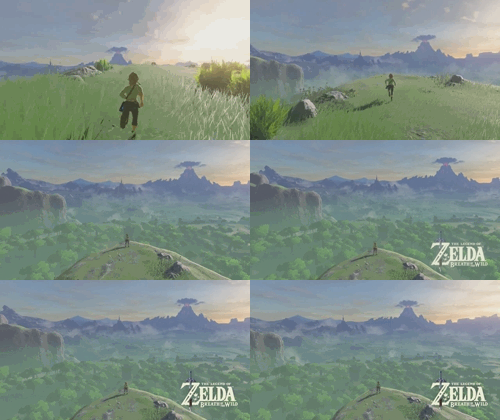
And they would still spend the next nine years debating where it fits in the timeline! And does anyone credit a loose 1995 RPG for inspiration? Nope!
Sometimes everything does not come together. And that is okay.
FGC #730 Lufia II: Rise of the Sinistrals
- System: We only ever saw this on the Super Nintendo. There was a Nintendo DS game that followed the same story, but that was a completely remade game. Maybe we’ll talk about that some day…
- Number of players: Final Fantasy 6 worked out 2-player RPG’ing in the same era. Why couldn’t you, Lufia 2?
- What’s in a name: In Lufia & The Fortress of Doom, Lufia is the name of one of the central characters. In Lufia II: Rise of the Sinistrals, Lufia is… nothing. Nobody. It means nothing. “The name of a girl that might get born in a century”. Maybe just stick to Estpolis next time.
- Art of the Era: Check out whatever is happening in the North American manual.

Final Fantasy 4 could only imagine.
- Every little thing she does is magic: When casting a spell, whether it be offensive or defensive, you can select one, all, or individual targets. Did you hear that, Final Fantasy? You can select the two ice giants with your fire spell, but leave the fire drake out. Or heal the members of your party that actually got hit, and ignore the dude at full HP. It is revolutionary! And it only happened, like, once!
- Occupancy Limit: You really feel the “there must be four party members, and only four party members” rule tugging against the game. It makes sense when Dekar heroically sacrifices himself, and then you can nab scientist Lexis for a dungeon or two. It makes a lot less sense when Dekar joins, and Guy has to cut out to do his laundry or whatever. And Artea is a legacy hire.
- Favorite Character: Dekar. Duh. Everybody says Dekar, and everybody is right.
 Favorite Capsule Monster: So Neverland stole the whole “airship works as a submarine” thing from Final Fantasy 5, which had released three years earlier. However, they invented friggen’ Pokémon a year early. You can find multiple, elemental-based capsule monsters across the world, and they all evolve through different forms according to what you feed them. You can even find specific “evolution items” to bring them up to secret levels! They are always fighting alongside you, even in scenes where it completely kills the tension or makes zero sense! And the Earth-based capsule monster, Sully, can become a moai head. Pokémon has not gotten around to one of those!
- What about the Ancient Cave? We will not be addressing rogue-likes at this time. Just be aware that this videogame contains an entire extra videogame, and everyone knows it.
- Wedding Bell Blues: Selan and Maxim get married over the course of their adventure. There are unique tuxedo and wedding dress sprites. It’s cute! Less cute is that Tia, Maxim’s (only) friend from before he started his adventure, is jealous enough to not only skip the wedding, but then also never be seen again. That’s cold. Though we can take solace in the fact that, in an RPG world, you do get married at your local save point.
- The guerilla fate is yearning: So Iris is a goddess that can see “Fate”, and she makes an early prediction that Maxim, Selan, and Guy will fight against the Sinistrals without Tia. But Iris also claims that Maxim was supposed to die fighting Gades, she impulsively saved Maxim, and now she cannot see the “new” future that has been created. But the thing is: Selan was not with Maxim when he fought Gades in the original prediction. She was on the sidelines, just like Tia. So Iris should have only seen a future where Maxim, Dekar, and Guy fight the Sinistrals before Maxim perishes. Selan-but-not-Tia being on hand only makes sense if Iris was seeing the “real” finale that she created. In closing, I hope someone got fired for that blunder.
 For the Sequel: So the most iconic bit of Lufia & the Fortress of Doom was that it started with what would be ending of this story. And Lufia II: Rise of the Sinistrals mostly plays straight with adhering to the ending that was established in a game released two years prior. However, since the whole “point” of that finale is that Selan is apprehensive about fighting gods, and then gets killed by practically nothing (god shrapnel? really?), it does seem like Selan uncharacteristically becomes an unwilling damsel in distress at the end of her own story. She was maximum Xena right up until that moment! And, for better or worse, the story does not have her “descend” into her established finale in any real way. She is ready to kick ass and take names right up until she arrives at the final dungeon. A shame, really. Not like they didn’t change a few things between games anyway, like, say, Maxim’s Dual Blade being a literal dual blade in the Lufia & The Fortress of Doom art.
- Did you know? Selan has Light magic in her spell list for the entire game. It is never used once, and has literally no purpose across everything. Until! It is featured at the absolute finale, because the Light spell was used to add a curtain raising effect to the Lufia & The Fortress of Doom prologue. Still, there could have been one dark cave elsewhere in the game for the tiniest establishment.
- Would I play again: Lufia II: Rise of the Sinistrals is hardest at the beginning, but contains a handy dandy New Game Plus so you can replay the game with 4x experience gains. So I may give it another go within the decade. It would give Maxim and Selan, like, one excuse to visit their baby again. I get that they are new parents, but they could say hi to whatshisname somewhere in there…
What’s next? Random ROB has chosen… Silver Surfer for the Nintendo Entertainment System! Sail the cosmos with an alliterative superhero! Please look forward to it!

Lufia II also has some of that Konami game manual energy in its very own. The paragraph somehow gets wronger and wronger as it continues.
“There are many different reasons for war: greed, a difference in beliefs, or a hunger for power. The Sinistrals started a war for the most selfish of reasons. They simply wanted the land of Lufia for their own. And they knew that the time to strike was when the Dual Blade, a sword of great power, was resonating. Arek, the leader of the Sinistrals, could read the signs. The Dual Blade would be his key to victory. The poor, pitiful Humans of the land would soon know the power of the Dual Blade. And Arek would have victory for once and for all.”
” And the Earth-based capsule monster, Sully, can become a moai head. Pokémon has not gotten around to one of those!”
Pokémon got around to those back in Gen 3. https://bulbapedia.bulbagarden.net/wiki/Nosepass_(Pok%C3%A9mon)
Nosepass is more nose than moai. Nosepass knows this in its bones.