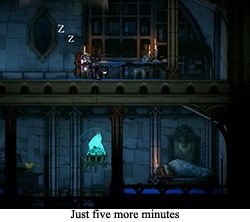

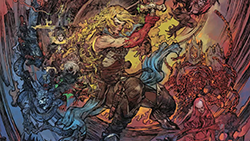
 I am starting to worry that videogames have a problem with death.
Castlevania: Belmont’s Curse is the latest Castlevania game from Konami. Give or take if we are counting Haunted Castle Revisited (official Goggle Bob statement: it don’t count), the last time we saw a potentially canon Castlevania title was 2009’s Castlevania: The Adventure ReBirth, and the last time we saw an official, 100% canon Metroidvania was Castlevania: Order of Ecclesia a year earlier. It has been eighteen years. While the Castlevania franchise has maintained a presence through collections, Netflix, and pachinko machines, the gap between “new” Castlevania games is old enough to vote. And after eighteen years of absence, what’s the first thing Castlevania: Belmont’s Curse does?
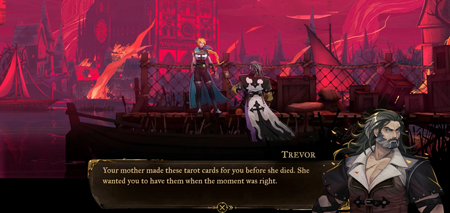
This is announced before the game even tells you how the controller works
Kill the first female playable character in the franchise! Yay! Party at the graveyard!
Technically the Castlevania timeline spans about 950 years, and everybody was already dead by the release of the Gameboy Advance (except Alucard. He has a longevity routine you wouldn’t believe). But Castlevania: Belmont’s Curse kicks off by explaining that the sensational character find of 2026, Rose Belmont, is the daughter of Trevor Belmont and Sypha Belnades. Previous Castlevania games did confirm that those two crazy vampire killers did have at least one Belmont brood. However, this is the first we are hearing that Sypha died shortly after her child’s birth, and the next generation of Belmonts (well, Belmont, singular) has literally no memory of the first woman to hit Dracula with a stick.
And boo! Boo I say!
 Look, I will admit that this is personal. Castlevania 3: Dracula’s Curse was one of the first games I played that lit my imagination ablaze. Unlike the previous two Castlevania titles that may as well have starred some dork named Ralph, Castlevania 3 made its three supporting cast members actual characters. Grant was forced to labor under a crooked curse! Alucard is the rebellious son of Dracula that will fight for humanity! And Sypha was my least favorite companion (mostly due to my own early onset OCD that prevented me from expending valuable hearts for any reason), but she was still someone I saw as a cool vampire-hunting lady that had a little bit of a Cyclops issue, and was now ready to save the world. I will not admit to fixating on these characters like some heroes from my childhood (Voltron, Optimus Prime… I think I may have just seen robots as authority figures), but I definitely have a significant fondness for them in all of their later incarnations. I will defend Mummy Grant! And, while it may have been a bit cliché for a shonen cartoon, the Sypha Belnades “action girl” that appeared in the Netflix Castlevania series was one of my favorite depictions of a spell slinger in all of media.
So it sucks that Sypha died all of five seconds after not appearing Castlevania: Curse of Darkness. The only playable woman in the Castlevania series for its first seven years (and, if we want to get technical, the next playable woman was distinctly preadolescent) deserved so much better than being the tragic backstory for the latest Castlevania woman.
And, like, Trevor is right there. He is not even letting go of the Vampire Killer. What are you saying, Castlevania? Manly men know how to survive in this Vampire-Eat-(Wo)Man world? Being able to command the very elements of Earth is nothing before your obligation to create playing cards for your unborn children?
So suffice to say I was not in a great mood when I started Castlevania: Belmont’s Curse.
And Castlevania: Belmont’s Curse puts its worst foot forward in gameplay as well. This is one of those situations where it is hard to say if any of these choices are bad, they just might be better labeled… hostile. Like, up until this point in the Castlevania franchise, healing was always handled by walls o’ meat, or a cornucopia of delicacies you could stow in your inventory for later. But how do you heal in this adventure? You have three health potions, and they refill at every save point. And that is Dark Souls. It is “modern game design” as we know it (albeit “modern” is a game from fifteen years back). Rose has a Souls-esque health system long before she has a usable whip. And you are expected to master this innovation to the franchise quickly, as the first boss drops about 75% of your health if he connects with a combo. 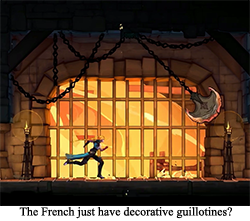 That is deliberate! You can easily make the argument that part of that boss fight is learning to use your potions effectively, and how you do not want to start chugging just when a flaming whip is about to hit your face. But this gameplay innovation is something from another series, and it being emphasized before you can toss a cross boomerang is suspect.
And then you get a whip! Sorta! You gain the ability to use a magical whip for traversal purposes, but an actual hit-skeletons-with-whip attack is blocked off for another few sections of the game. What do you get before that? Some Guacamelee!-esque ability used for parrying and activating/deactivating certain specially marked blocks! You know! Like in no Castlevanias ever!
“This is not your daddy’s Castlevania” is the moral of much of the opening of Castlevania: Belmont’s Curse. Rose is a new heroine with her own selection of powers and abilities, and everything is going to be different this time. Until, inevitably, it isn’t. As the game progresses, the “normal” (later) Castlevania expectations, like a double jump or the Vampire Killer, trickle into frame. By the time Rose is facing Dracula (spoilers: the Dracula game has Dracula in it), you will have forgotten there was ever a time you couldn’t slide – jump – air dash your way through a thousand spinning gears. It is not quite a bat transformation, but Rose upgrades her repertoire to something that could explore any castle just as well as Alucard or Soma. And just like them, too!
But in the meanwhile, Rose is likely going to die. A lot. And that brings us to our other modern gaming convenience that is getting a little weird: death means nothing.
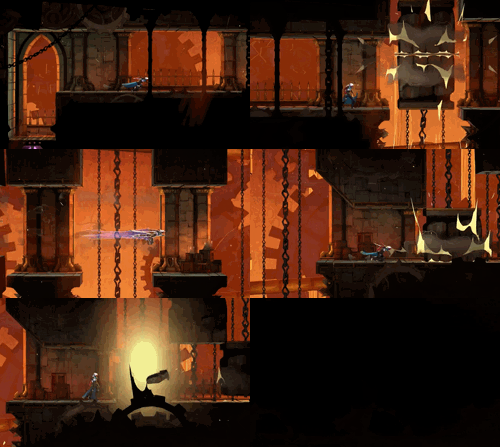 Ornate, magical mirrors are save points for this Castlevania adventure, and they restore Rose’s health (and health potions) in addition to saving your data. And, while any death could simply load your state from the last save mirror, you do distinctly “respawn” after a death. What’s the difference? Well, the various towers and dungeons of Paris have all sorts of traps and unruly undead, but they also have a variety of shortcuts. It is a common phenomenon that once you complete a “room” or two of trials, you will find some bolted door that can now be unlocked, or a platform that can be moved into an advantageous position. Thus, the next time you are traversing this area, you can immediately zoom back to the incomplete challenges. Why would there be incomplete challenges? Well, because you died. While these shortcuts are certainly helpful in the late game while you are trying to track down maximum map completion, so many different areas at the start never need to be visited again. Both the second and third bosses are cordoned off in areas that do not need to be revisited. But you will see those areas a lot if you are dying a lot. Complete with boss runback, it is undeniable that these areas are built to be gradually completed, with assorted faster paths unlocked along the way. Lost too much health in that last harpy fight? Don’t worry about it! You just unlocked a door, so you can bypass the battle next time! Sure, you will spend a little extra time schlepping back from the mirror, but we would hate to make dying as a bloody pulp inconvenient.
Sypha died. Her death is arguably the driving force for her daughter and many of the decisions she makes over the course of her adventure. Sypha’s death is the most important thing that has ever happened to Rose. Rose’s own death(s) is barely even an inconvenience.
As much as people complained about the Dark Souls-ification of games like Shovel Knight and Mina the Hollower (and I’m sure there were retro titles that were not produced by Yacht Club Games, too), at least fighting to win back your sparks, bones, or money bags acknowledged that death had a consequence. Mina the Hollower even designated it as a significant part of the plot! The technology that was constantly reviving you did have some drawbacks! But in this gothic horror setting where you visit real-life tombs beneath one of the most famous cities in history? No downside to death! Die over and over again, and it is barely a hiccup. There are rooms with wall-to-wall buzzsaws where it is implied Rose is shredded to bloody pieces dozens of times. And it is no problem! Rose dies screaming, and she respawns at the nearest solid ground. You don’t even have to sort through the hassle of hiking back from a mirror. Belmonts apparently have red skeletons! She’ll be fine!
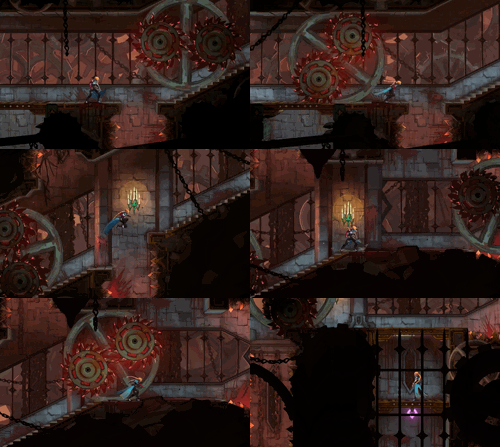 Yes, it’s a videogame. We just agree that one woman with a deck of cards is practically invincible anyway. We are not going to produce a hundred screeds about how a person in 1499 should die of sepsis five seconds into her journey after soaking a wound from one (skeleton fired) arrow. Humans are fragile! Death is terrible! And whether it is Mario or a vampire hunter, we just agree that death is a natural part of videogames. You died, start again.
But something has gotten lost along the way. For all the ways later games have aped Dark Souls, for all the modern innovations we see in retro franchises, pieces are still missing. You are a horrible little freak in the world of Elden Ring, and when you die and are reborn, it is a further affirmation of how you are a monster. In Castlevania, when you are set against the legions of the grotesque undead, and you are dealing with a curse that makes malevolent statues talk to you, you still must be the shining, glorious Belmont, so death cannot be acknowledged. After a bad ending, the one time the game recognizes Rose’s death, you get a silly trophy and a non-canon costume for your trouble, and the enigmatic Ferryman says, “Ha ha, don’t do that again, dummy.” The Grim Reaper, Death himself, is a persistent antagonist! And long before the signature boss fight, you learn he cannot do a damned thing to you.
Videogames, you have to make up your mind. You can either make death the most important thing that happens to a person, or make death meaningless, but you cannot do both.
Alright, now that that is out of the way, I can explain why Castlevania: Belmont’s Curse is one of my favorite games of the year. What? The article is already too long? Oh well. I suppose time comes for us all.
FGC #750 Castlevania: Belmont’s Curse
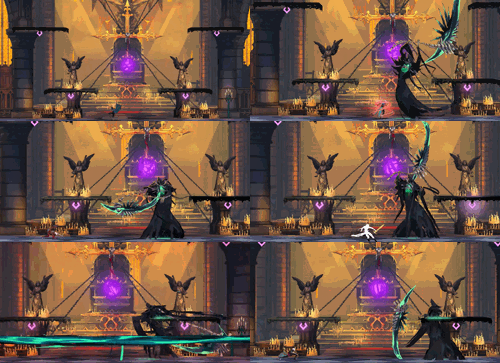 System: The usual suspects are all here. Nintendo Switch, Playstation 5, PC, and Xbox X|S are your choices. I played it on the Playstation 5, predominantly so it can hang out with Castlevania: Symphony of the Night.
- Number of players: Rose, alone, against the world. Come to think of it, we missed out on a “play as a random rival character” mode this time.
- Maybe actually talk about why you like the game for a second: I had genuine concerns from early reviews and Prince of Persia: The Lost Crown that this would not feel enough like a Castlevania to scratch that itch, or be something akin to Metroid: Samus Returns where you are constantly interrupted by “combat requirements” when you are just trying to fish out a missile tank. In playing it, I found this is definitely not an IgaVania, but it is still very reverent to the series in both lore and gameplay. This could have been another Lords of Shadow! Which also killed Sypha! But the overall “flow” of C:BC feels right, and that is exactly what I want from a 2-D Castlevania.
- Favorite Weapon: I spent the first half of the game grapple-whipping to monsters, and then punching them square in the face. Sometimes stabbing was involved. Then I got the Vampire Killer at about the halfway point, and I never looked back. Is a mandatory weapon supposed to be this good? Is it a reward for finding the “secret” route to the good ending? It is weird how it is so unbeatable as your best option in 90% of situations? See also the weirdness of how I was missing many Tier 2 & 3 weapons when I first completed the game, but all the Tier 4 weapons are placed under billboards and giant neon signs and sometimes they send you a handwritten invitation in the mail. I wonder if there is even any way you can get to the real ending without obtaining the Vampire Killer…
- Always Overlooked: Grant DaNasty is nowhere. There are more references to a set of knuckles that Alucard got one time than our favorite maybe-pirate dude. There are more references to fuggin’ Walter’s signature weapon! Walter! Nobody wants to remember Walter! Justice for the DaNasty clan!
 What was missing: I did not realize until about the 60% point that there are no shops, money, or crafting systems involved here. Good! Not to poke at the sacred cow (bat?), but Symphony of the Night never needed librarian commerce, and Soma never needed to collect seventeen skeleton souls to make a sword. If you want random requirements, the tarot cards each have their own little challenges, and those are just chill enough to be tolerable. A Castlevania without grinding is a good Castlevania.
- Bossing Around: Between the tarot chats, the “clues” sprinkled about, and actual conversations before battles, I really appreciate how the “boss monsters” feel like creatures with motivations and relationships to other monsters, and not just giant beasts that wait in a room for a Belmont to show up. Medusa has interiority! And a few of the bosses are inexplicable figures from history! Castlevania took one guy who was known to work on one building nearly a thousand years ago, and said, “Yeah, he would probably sell his soul to the devil to become a giant robot.” Please do not tell his descendants.
- Making things Difficult: That said, while I did not experience any sort of “you’re under-leveled” issues with the rank and file of Dracula’s army, there were a number of places where I felt like I was battling bosses “out of order” thanks to their (or my) damage output. On my playthrough, the Zealot could turn Rose to mush in the three hits, but the Miser was in the ground before he got a turn. Maybe Castlevania doesn’t need a leveling system, either? Those difficulty sliders are right there if you want a battle to go your way (or if you’re a masochist).
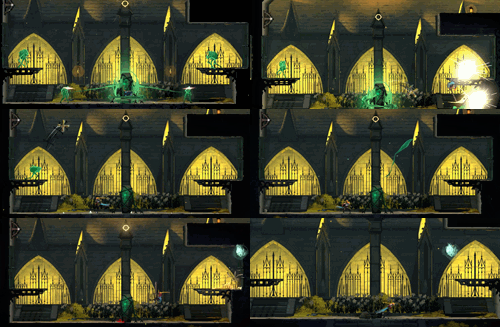
- Most Improved Odor Trophy: The bestiary here feels small, but Nova Skeletons are gloriously back. In prior titles, they were placed in vaguely annoying places, and the general challenge was “don’t get hit by the super beam, dummy”. But! In this Castlevania, they are repeatedly placed just outside of view and on the same plane as you. So you see the Nova Skeleton activating from afar with a signature “here comes something” vacuum line, and there is genuine tension with “oh no, I gotta get out of the way of this beam!” And you usually must grapple up to something to get out of the way, or duck down a platform, or something. And then you run into a few Nova Skeletons in tight hallways, so now you have to find a way to close the gap as quickly as possible to knock ’em out before you get beamed. And it is rad! It feels like taking an old Castlevania monster, and constructing genuinely new situations out of ’em. Good job, monster level design!
- Did you know? Rose never fights a cyclops. There are many returning Castlevania monsters, but they did not include the one that stoned Sypha, and is arguably the reason Rose was ever conceived. You would think they’d give the guy a look.
- Would I play again: Yes. And please give me some weird DLC while you’re at it. Maybe something with Grant? We need more Grant.
What’s next? Random ROB is helping us close out Even Worse Streams Sonic the Hedgehog coverage with… Sonic Superstars! And then we won’t talk about that hedgehog again! Probably! Please look forward to it!