

 If you are going to open your mouth, at least know how to talk.
Batman: Caped Crusader released its second season this past Summer. For anyone that missed Amazon’s media blitz, this is a Batman animated series developed by Bruce Timm, produced by J.J. Abrams, and starring a murderers’ row of amazing acting talent. John DiMaggio! Cedric Yarbrough! Christina Ricci! The guys who played Tidus and Sora! Fryda Wolff! Kevin Michael Richardson! How could I possibly resist!? Well… Sorry to say that there is only so much space for Batman in my brain. This feels insane! I should have room in my heart for infinity Batman! But the basic premise of Batman: Caped Crusader is that, despite this series taking overt cues from Batman: The Animated Series (1992), this is a separate continuity in a distinct era. It is noir! It is some nebulous Mid-20th Century (it really wants to be the 1940’s, but everybody owns a TV…) where tommy guns and trenchcoats reign supreme. And that means I have to deal with all that damned Batman reboot nonsense! I have to live through another death of the Wayne parents! I have to sit through an episode that establishes the exact dynamic between Alfred and his idiosyncratic employer! I have to absorb a whole new quasi-origin for The Joker! Does this one involve Lady Gaga? I don’t know! I don’t want to know! Who has time for this bat guano!?
But I am part of a weak and cowardly lot… that may have recently gotten on a bit of a Pokémon kick that necessitated watching something in the “background” while farming dratini… and I decided to submit and watch Batman: Caped Crusader. I am full of Batman, but I suppose one wafer-thin mint of additional Batman content couldn’t hurt.
And it was good! It was really good! So now I am exploding with a Batman take:
I care about fictional characters.
Wait! Don’t leave! I swear this is a fresh take! This is not baby’s first encounter with pareidolia. Of course I care about fictional philanthropist Bruce Wayne, and obviously I can name the majority of his rogues’ gallery faster than I could produce my grandfather’s middle name (it is the same name as a former/infamous presidential candidate, but not the one you would expect). This is not another half-baked attempt to justify why a 40-something cares about the status of Barbara Gordon’s legs (not like that). This is something new and different and only vaguely concerning.
What I realized in watching Batman: Caped Crusader is that I not only care about continuity as a concept, but continuity is the essence of humanity.
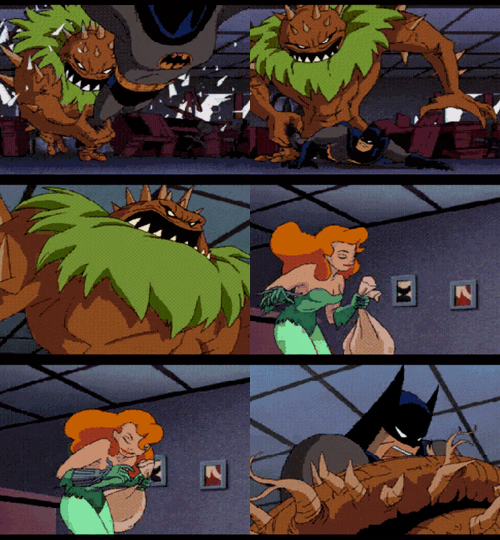 Batman is a comic book hero. He first appeared in Detective Comics #27, initially published on March 30, 1939. “Batman” as a concept is nearly a century old. And two things are true: in those 87 years, Batman has had one solid continuity of stories, and also Batman has never not contradicted everything that came before. Batman has an entire family of supporting characters (except when he is a known loner). Batman hates guns (except when he shoots everyone from petty criminals to space gods). Batman is a fighter trained by the world’s greatest martial artists, and is currently in a life-or-death struggle with a houseplant (it is very large). But, give or take the occasional cosmic shift in (his) reality, Batman has always had one story that moved forward from month to month. Sure, in 2026, stories from 1939 no longer “count”, but that was not true in 1942. Even when an Infinite Crisis or Earth-2 enters the picture, everything is perfectly normal for a couple of years, and it is only after a long enough time has passed that Robin gets to say “Hey, didn’t you used to have a daughter with Catwoman? What was that about?” Continuity as we know it is not bound by what happened half a century back, but it is absolutely beholden to a trade paperback from earlier that year. Who cares if The Flash messed up the entire universe thanks to his Oedipus complex, Batman Inc. must reach its conclusion!
And every nerd will tell you that this is the bane of comic books. Batman, Superman, and Green Lantern are all bound by their immediate continuity, and that is distinctly bad for the audience. Are you a Sonic the Hedgehog fan, and want to read his latest crossover where he meets the heroes of the DC Universe? Well, you better know what is happening over there! There are sixty ways “this” Justice League is different from the one you last saw, so you may want to grab a pen to take some notes on Aquaman’s current number of hands (it’s two). And that is too much homework for a story where the finale is “hedgehog beat eggman”! Whether we are talking about The Avengers, The X-Men, or even the Doom Patrol, every time you are encouraged to pick up a “#1” of some relaunch or a crossover that could be interesting, you are inundated with continuity snarls that beg you to read previous issues. Sure, you can read this comic without knowing about Ms. Marvel’s sidekick’s love life. But don’t you want to know? Don’t you want the drama to be informed by what has come before? You don’t want to only see the slam-bang finish, you want to see every domino fall in its proper order.
And that is human. It is literally how our brains work.
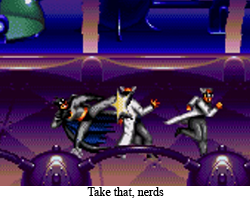 What separates humans from the animals? Give or take some talky dolphins, we are the only species on this planet that has worked out standardized communication. We train our young to learn the dialect of the area, and we cooperate in society by utilizing shared language. We have even invented devices that exist exclusively to translate between different cultures! And when we have relationships? Those are languages, too. All the little inside jokes and references to Drunken Uncle Franny and even ongoing conversations about old episodes of Cheers contribute to what becomes the language of a relationship. Tell me your favorite group chat doesn’t have its own version of the infamous Grink meme. You absolutely talk to your boss with different speech from what you use with your buddies. And you know you still regret how you’ll never again be in a place with an ex where you can make jokes about The Shame Shawarma. We make our own languages with everyone we encounter, and the nuance of those languages only increases with the care we feel for others.
So, yeah, I speak Batman. And since I speak Batman, I care about when someone talking about Batman gets it wrong.
There were four games named The Adventures of Batman & Robin released between 1994 and 1995. The Super Nintendo version was produced by Konami, and, thanks to that pedigree, it is a competent action/platformer/adventure title. The Game Gear version was created by Novotrade (later Appaloosa), and it is… a licensed Game Gear game. It ain’t no Ren & Stimpy. The other two versions of The Adventures of Batman & Robin were designed by Clockwork Tortoise. The Sega Genesis version was an action title, and the Sega CD version was (essentially) a racing game. Neither are bad games, but they have their… quirks.
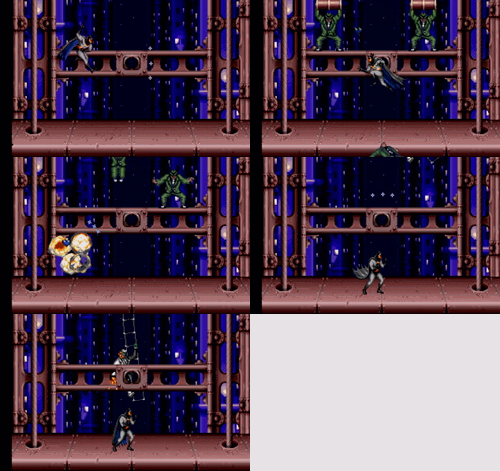
Let’s tackle The Adventures of Batman & Robin for the Sega Genesis first. Like the SNES/GG TAoBaR titles, this one can be generally described as a 2-D action title. Run, jump, attack: you know the drill. But unlike its contemporaries, it is basically Contra. Two player simultaneous play is available, and Batman and/or Robin dash through four extensive levels while pegging every moving object in Gotham with a flurry of batarangs. The gimmick here is that the longer you go without shooting, the stronger your attacks will become, but the continual onslaught of roughly half the city’s population means you will prefer rapid fire. You have a cool jump kick available, and you can throw a punch if an opponent is literally on top of your protagonist, but other than that, it is just Batman and/or Robin tossing out projectiles continually. To drive the point home, three out of four of the levels contain a straight up, Gradius-style shoot ’em up section. Fly the night skies and obliterate an airforce! I guess!
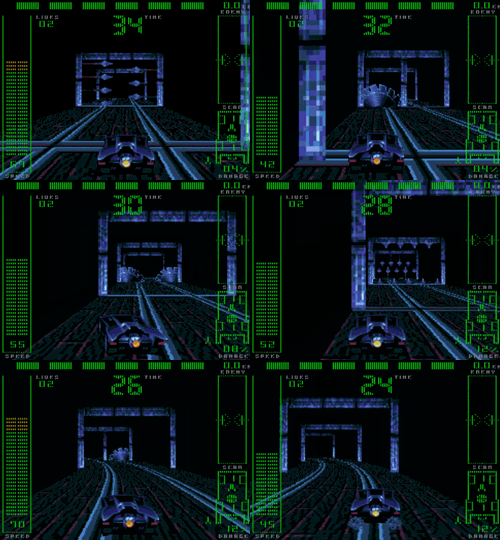 Meanwhile, the Sega CD version of The Adventures of Batman & Robin is entirely confined to the Batmobile. SCD TAoBaR contains (surprisingly awesome) cutscenes that portray Batman defeating his various foes, so your job as the player is to get Batman on set in time for his closeup. The first three challenges are driving around the streets of Gotham, but you graduate to a virtual reality world and a mad funhouse in short order. Oh! And you do eventually advance from the Batmobile to the Batplane (really, spell check? You acknowledge “Batmobile” as a proper noun, but not “Batplane”?) for the finale. It is just Batmobile racing with an added vertical axis, but it feels like something new and exciting.
However, the impact of Batman flying is lessened, because Batman has hopped into his custom flyer to pursue… Clayface. You know, the Terran-based monster man that can transform into practically any shape? He is flying away in a helicopter. And, no, the whirling blade is not made from his morphing arm or whatever. It’s just… a helicopter. Clayface: noted flying guy.
And this is where it feels like Clockwork Tortoise is getting Batman wrong. The Batmobile is cool! Everyone loves the Batmobile! But, give or take Gearhead, none of Batman’s villains are cars. You controlling the Batmobile (and, to a lesser extent, the Batplane) means you, the player, will never actually interact with any of Batman’s favorite frenemies. How will Batman defeat The Joker? Or The Riddler? Well, you just sit back and watch how that happens, because Batman sure ain’t gonna run ‘em over. It is a waste of a perfectly good mud monster to have Clayface participate in a plane race. And Poison Ivy? She summons a plant monster that is only seen in cutscenes. It would have been cool to fight that thing!
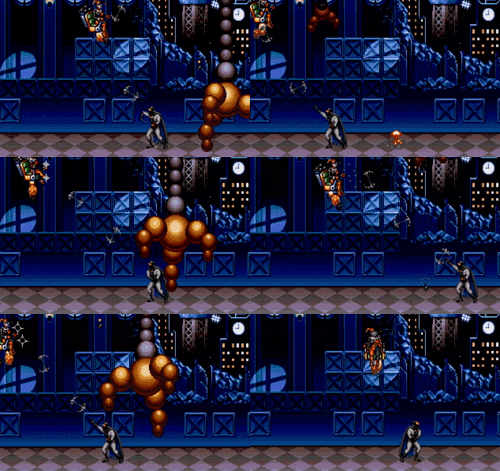 That takes us back to the Sega Genesis version for the other side of the coin: Batman villains are mostly just dudes. And that is okay! You can get a lot of mileage out of Batman and Joker punching each other. But! Once you stick Batman in a run ‘n gun game, suddenly all of Batman’s villains must be practically invincible. Acrobatic Harley Quinn gets a giant clown tank to top off the first stage. The Joker has an enormous, smile-themed hot air balloon. Notorious glass jaw Mad Hatter takes a hundred hits thanks to the excuse of a virtual world. Mr. Freeze is the final boss, and his freeze suit (?) can be physically intimidating, but he also gets a floating platform, so he winds up functioning like Dr. Wily. It is the nature of a Contra-alike that no opponent worth their salt bows out after a hit or two. Batman is tossing enough batarangs to bankrupt the Wayne family fortune, and Joker just keeps laughing. … Okay, maybe that is a bad example. Two Face has an airship! It is not even shaped like a giant silver dollar! Bro would never drive that generic trash off the lot!
I will reiterate that neither of these games are bad. For a pair of titles released in the early 90’s, they would have been more enjoyable in their era than a healthy portion of what GamePro was peddling. Not something you could hang your whole personality on like Chrono Trigger or The Ooze, but more of a justification for your Sega CD than Sewer Shark. However, these games are bad Batman games. They get Batman wrong. Or, to be precise, they get the experience of Batman battling through his foes wrong. All the pieces are there, they know all the words, but it is disjointed and confusing. The games do not fluently speak Batman. And, when the language is incorrect, everything falls apart. Car-battling Joker was never part of the phonetics, and now the whole verse is coming out criminal.
Batman: Caped Crusader is different, but it gets the language of Batman right, so it is amazing.
The Adventures of Batman & Robin for Sega Genesis and The Adventures of Batman & Robin for Sega CD are both unique, but they get the language of Batman wrong, so they are terrible.
Always understand your language before speaking.
FGC #747 The Adventures of Batman & Robin (Clockwork Tortoise Editions)
 System: We are exclusively talking about the Sega Genesis and Sega CD versions today. They are totally different! But we are only talking about two games with the same name, not four.
- Number of players: Two on the Sega Genesis, one on the Sega CD. Batman drives alone.
- A Common Plot: You can play as Robin in the Sega Genesis version. In the Sega CD version, all of Batman’s allies (Robin, Commissioner Gordon, Batman’s ability to walk) have been kidnapped. This is exactly what happened in another DCAU adaption, Superman 64. Though it was unlikely you were ever going to get a playable Professor Hamilton in that one…
- Come to think of it: Apropos of the last bullet point, Jimmy Olsen should have his own videogame. Think of the situations!
- What’s in a name? So Clockwork Tortoise made two Batman games, but Batman does not fight the Clock King in either one? Boo.
- Escalating difficulty: The worst/hardest part of the Sega CD version is the opening stage. In addition to dodging damage, you also must avoid bumping any civilian vehicles, lest Batman be declared a menace to society. It is so much easier in later stages when you only have to worry about Batman being exploded!
- What Could Have Been: I would love to know more about the development of the Sega CD game. You have situations like Poison Ivy summoning a distinctive monster, old ‘n fat Rupert Thorne being revealed as Clayface, and Harley Quinn generally buzzing around all implying dramatic boss battles … but they come to nothing. Harley Quinn in particular is like “look at me, I’m here” and then smacks into a wall, never to be seen again. I would give Mad Hatter’s finest topper to know if these are just coincidental non sequiturs, or part of a planned (better) game.
- Meanwhile, on the Sega Genesis: The first area of Level 2 of the Genesis version is an escalating elevator where you fight hordes of goons. So, technically, this is legally a beat ‘em up.
- Say something nice: After the elevator, Level 2 also has a cool graphical scrolling effect for its shoot ‘em up area that I do not remember seeing anywhere else in the 16-bit era. It adds absolutely nothing to the gameplay, but it is cool to look at. That adds something! I guess!
- Art Deco: All the SG stages start with a “title card” similar to Batman: The Animated Series art. Or maybe exactly the same? Regardless, they are also cool to look at.
- Did you know? Batman: The Animated Series had a number of censors placed on its production. Sex and drugs were obviously right out, but they were also not allowed to show more mundane events, like a child being endangered, or glass being broken. They were technically not even allowed to show a punch connecting! So when original animation was produced for the unrestricted Sega CD…
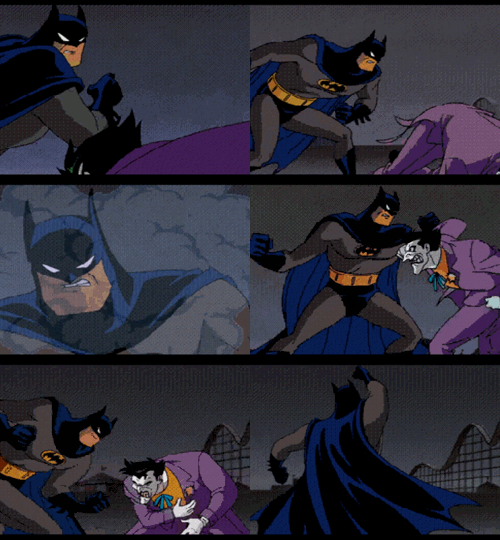
It looks like Bruce Timm was working out some frustrations.
- Would I play again: No. These are fascinating Batman games, but they are not good Batman games. I will finally get around to playing Arkham Asylum again before I ever toss a batarang with these guys.
What’s next? Random ROB has chosen… Mega Man X Regenesis! More Mega Man and fan gaming! Oh boy! Please look forward to it!
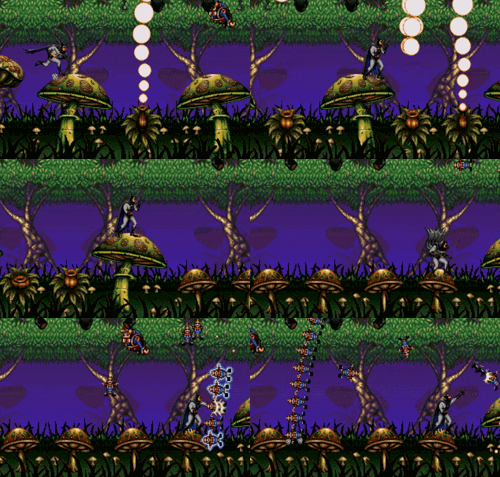
Batman saves the Mushroom Kingdom
Hey, uh, Robert, bad news about the whole “none of Batman’s villains are on wheels” thing, if you don’t keep up with kiddie-show superhero adaptations.