
 Can we just stop the generational discourse for a decade or so?
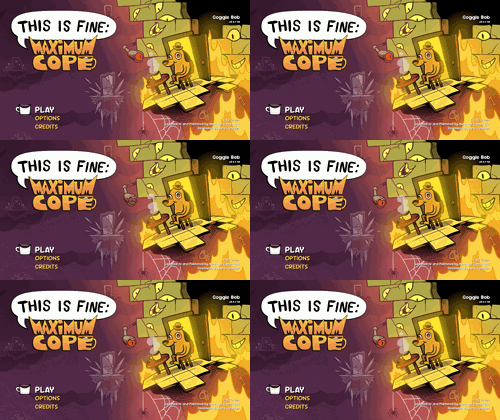
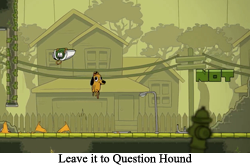
Today we are looking at This Is Fine: Maximum Cope. This is a game based on one panel from one comic strip. KC Green’s 2013 Gunshow webcomic gave us Question Hound’s “this is fine” meme, and, eleven years later, a Kickstarter project and Numskull Games constructed a videogame based on that celebrated declarative statement. This is Fine: Maximum Cope is billed as a metroidvania, but this pedantic nerd is going to refute that nomenclature: This is Fine: Maximum Cope is five themed levels that are each varying levels of collectathon (the word “collectathon” is used within the text of the adventure, so I don’t want to hear any protests), and you are encouraged to revisit earlier levels with freshly earned abilities to earn a few extra souvenirs. Is there ever a situation where you must return to previous areas? Nope! So we are going to go ahead and label this one an action platformer with search elements and an expanding moveset. See? Much more precise!
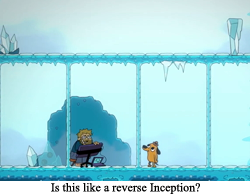
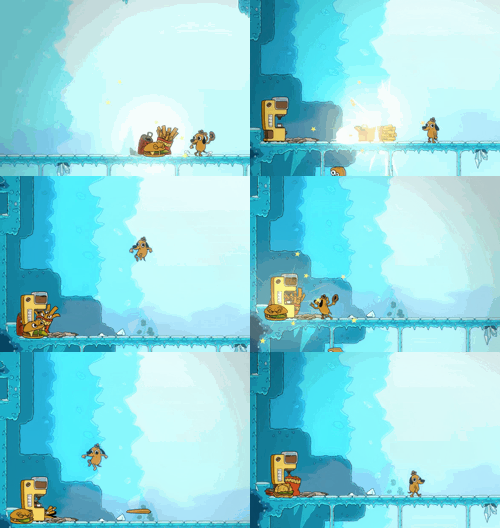
But now that we have defined this as a levels-based game, we need to talk about those individual levels. They are pretty great! You are playing the role of Question Hound who, for reasons that are never explained, is now trapped inside his own mind. Presumably to work out some issues, Question Hound must venture through five sectors of his subconscious: Humiliation, Fear, Failure, Loss, and Regret. Working backwards from the finale, Regret is the most affecting stage, as every area contained therein is based on a different vice. This means battling through ice caves (because ice is reflective, duh) that remind Question Hound/you of days spent bloated on fast food or nights drunk on alcoholic binges. Even if you do not have an unfortunate tattoo or have never sent a lamentable wall of text out onto the internet, the Regret examples/areas feel fresh and universal. Similarly, the previous level’s Loss is grounded in a hospital. This area feels a little more puerile than Regret due to not developing into anything more complicated than “death sucks” (Freud called, he wants his Thanatos back). But seeing a door labeled “Loss”, and finding it opens to a hospital parking lot is a gut punch. Regret and Loss, the fourth and fifth levels in this five-level game, more than justify the game’s concept of adventuring through the mental hangups of an everyman (dog).
And the other levels are… uh… there… I guess.
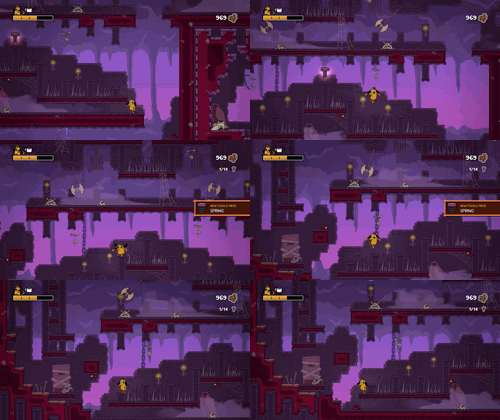 Fear, the second stage, is unique in being some kind of broad awful. The other four stages are based on abstractions of real situations that may play on the average adult’s mind. Fear is a haunted house. There are murder clowns, possessed dolls, and an overabundance of magical sharks. And these are certainly things that can inspire fear. But they are no more “real” as a threat than a movie monster or videogame opponent. All of the other stages transform mundane annoyances into superpowered threats. Fear is practically indistinguishable from Luigi’s Mansion (the haunted one, not the one he got from all that Illumination dough). The final boss of the area is a giant spider, and the following cinema does seem to make a gesture at “see, spiders aren’t scary, they’re just little dudes”, but that does not hit after an army of screaming monsters. There are a thousand things that scare me in real life! None of them can be found at Spirit Halloween (except maybe my fear of asking an employee where I can find their “sexy pocket monster trainer” costumes).
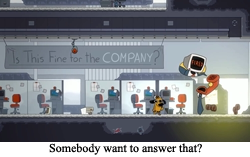
But the disappointment of Fear pales before the mundanity of Humiliation and Failure. Humiliation, the first stage (and introduction to this entire game/concept), is a trip through a mutated memory of high school. In this case, it is vaguely prom-themed, and the puzzle of the area recounts Question Hound’s embarrassing, tear-filled, dateless trip to that school dance. The final boss is a literal Queen Bee with a pair of drones, a cheer routine, and a summonable school bus. Similarly, Failure is a Dilbertian office of undefined “work”, and the challenges are based around phone cards and offensive cursors. The boss is… the boss, and he is represented by a sentient, bipolar PC. The sins of these stages are twofold: firstly, these are the absolutely most all-purpose “relatable” examples of modern psychological torture that could ever exist. But on top of that, this means that their stages/monsters/bosses/puzzles become wildly generic. This game is about travelling the mind of a person (dog) working through trauma! The levels could be anything! But “generic school” and “generic office” with enemies themed after exaggerations of threats in their respective areas could be featured in practically any game. In fact, with the broad “suburban neighborhood” area outside the school kicking off Question Hound’s quest, This is Fine: Maximum Cope immediately reminded me of Rocko’s Modern Life: Spunky’s Dangerous Day.
And that is about when I realized that nothing ever changes.
 Some of my first games were licensed titles. Chip ‘n Dale Rescue Rangers was great! Bart vs. The Space Mutants… Not so much. But by about the time I was eleven, I had learned that “licensed games” generally meant “crap” (dating this according to the release of Home Improvement: Power Tool Pursuit!). This was not universal! The Teenage Mutant Ninja Turtle beat ‘em ups of the era were some of the best to ever do it, but that was also a franchise about ninja mutants fighting ninja robots. It is harder to adapt a cartoon that is essentially a sitcom, or a movie about the kids of Bebe. Thus, there was a time from roughly the Super Nintendo era to the establishment of the Playstation 3 that I would avoid licensed titles like the plague. In fact, it was not so much the plague, but a feeling that I was “too cool” to be tricked by a Kim Possible or Celebrity Death Match jaunt. And what eventually changed? Licensed games did not get overwhelmingly better, I simply had more disposable income. When a single game cartridge was my entire gaming budget for the season, I had to dodge Shaq-Fu like a flaming basketball. Years later, when The Lord of the Rings: Gollum was sitting in a discount bin and would cost me less than a supreme burrito, I had dramatically less objections. War never changes, but this soldier did right around when he could afford that Rugrats game without thinking.
But whether I was ever buying those licensed titles, they kept making ‘em straight from Friday the 13th (1989) to Friday the 13th: Jason Universe (TBA). I may have hopped off the train for a little bit, but people were chugging along and making these ventures financially viable at every stop. If a game is based on an action title, then hooray, you can play as a protagonist fighting their familiar villains. If a game is based on something more mundane, then maybe it will be enjoyable to play with a few funny jokes between levels. You want Gravity Falls: Legend of the Gnome Gemulets for the Nintendo 3DS? It ought to at least have some hilarious dialogue in there! Or a puking gnome! A random rhythm game or action title on the Nintendo Switch eShop could be anything; however, you are likely to drop some cash if you see a Nicktoon on the cover. You at least are going to recognize the protagonist. That’s something!
In this case, the protagonist is the star of a ubiquitous meme. And his curators had to wring pathos out of a panel.
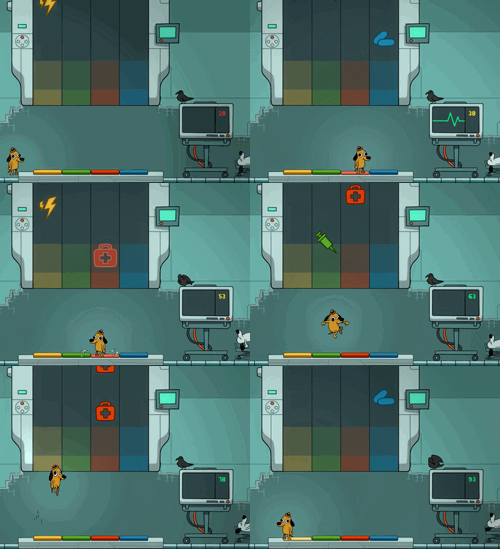 This Is Fine: Maximum Cope went wide. It is an action platformer, which is a very popular gaming genre (as determined by the sheer volume of similar games currently available on all digital storefronts) that dates back to the NES. Its stated story is based on improving Question Hound’s mental health, but that shakes down to individual levels that are infinitely established tropes. Being an outcast in high school or hating the drudgery of your office job was an exhausted cliché in the 1980s. Need some numbers on that? Well, the recurring animated short Milton, which eventually evolved into Mike Judge’s Office Space, premiered on Saturday Night Live in 1990. To be clear, that is not “the 90’s”, but 1990, as in the year after the end of the Cold War. And even the efforts of John Krasinski have not produced a new “cube farm” joke since. Square Pegs, the sitcom all about awkwardly trying to fit in in a modern high school environment (and inexplicably starring Sarah Jessica Parker as a turbo nerd) premiered in 1982. The show’s every-episode-introduction observations recounting high school cliques and the humiliation of not fitting in are not only older than the This is Fine meme, they are older than the man that created Question Hound in the first place. We, as a society, have been recycling the same jokes about high school humiliation, failure in the eyes of inscrutable bosses, and even nigh mythical “the high school quarterback, king of the school” for decades now. When someone needed to pad out a videogame about a dog-man with problems, of course they went back to the same well. It is the only thing anyone has drunk for the last fifty years!
This Is Fine: Maximum Cope is an excellent videogame. The art style is entertaining, and the animations are impeccable from both an aesthetic and gameplay perspective (turns out smear frames are great for telegraphing dodge windows). There is clever gameplay plotting with seemingly random “statue challenges” that subtly prepare you for the final boss. Aside dialogue between Question Hound and his conscience creatures is always amusing. Collecting coffee beans makes the most satisfying “crunch” sound. I have no reservations about recommending this game. This Is Fine: Maximum Cope is better than fine, it is fantastic. But, on some level, it is just this generation’s The Flintstones: The Rescue of Dino & Hoppy. It is a meme from a gag-based webcomic that now must be expanded to a videogame that will last an entire afternoon.
It is 1990, and you are fighting a giant spider boss in Gremlins 2: The New Batch on the Nintendo Entertainment System.
It is 2026, and you are fighting a giant spider boss in This Is Fine: Maximum Cope on the Nintendo Switch 2.
Every generation gets the same beats. Every generation gets the same jokes. Every generation gets the same frustrating spider boss.
Olds, be kind to the young, they are still digging through leftovers from before we were born.
FGC #733 This Is Fine: Maximum Cope
 System: Nintendo Switch (give or take 2) for the article, but also available on Playstation 4/5, Xbox X|S, and Steam.
- Number of players: This game is like Metroid in how its protagonist does not meet a single other helpful creature throughout the entire game. One single player against the world (inside his head).
- Hey, I know that dog: You drink coffee to restore health points, and rest at a “This is Fine” diorama as your recurring save point. Flames pop up only when you are sitting there. It feels like some kind of contractual obligation to satisfy the source material. It is fine.
- Hey, I know that guy: There is a different shopkeeper in every level, and they are all cameos. The final stage features author KC Green himself, and the Fear stage justifies its existence by including a disturbing chimera of the nerds from The Anime Club. The kids are alright/horribly mutated.
- Favorite KC Green Comic: Are you going to get mad at me if I say I feel Question Hound was a random flash in the pan, and the best KC Green comic was back in HorribleVille? Or… Well… I suppose it is important to simply note that “this is fine” or dickbutt pale in comparison to me randomly shouting “lake break” before leaving any location.
Maybe the Greatures will one day reach the echelon of that illiterate fish.
- Say Something Mean: There are random occasions (twice in the Fear stage!) where the doggie dialogue will cut in, but monsters and Question Hound are still completing their movements. So the poor dog got hit while he couldn’t move! Or he fell into some manner of blood lake! And that really hurts in the early stages when you have approximately zero health.
 Pedantry Continues: And the other reason I cannot call this a metroidvania is that there is one “offense” powerup in the entire game (and it is entirely optional). Other than that, all your upgrades are only movement based, and the best you can hope for is maybe your hat-duck helps you avoid an attack. One level rewards you with a wall jump. And the next level’s boss arena does not contain walls! Argh! At least your hat boomerang is a cool way to put down sentient varsity jackets.
- An End: The final boss activates a save point right before its start, and you have no capability of exiting the stage or returning to an earlier area to stock up on supplies until the final boss is trounced. Hey! Maybe this is a Metroidvania! Super Metroid has a similar fatal flaw!
- Did you know? The gorgeous art and animation of This Is Fine: Maximum Cope has drawn many comparisons to Cuphead. And I get it, but I don’t really see it. Cuphead was distinctly going for Hollywood animation’s earliest style, while This is Fine: Maximum Cope has a significantly separate, more modern style. Comparing the two just because they look phenomenal feels like comparing Metallica and Johnny Cash for both being “good at music”. That said, both games end with a massive boss fight against Devil from Bible, so there is some shared DNA there.
- Would I play again: Unfortunately, This is Fine: Maximum Cope does have the issue of earlier bosses/areas being much more difficult before you obtain the upgrades and “ease of life” bonuses of later stages (did I mention this game can have fall damage? That’s never good). A New Game Plus would be delightful, because replaying the earlier stages with a full loadout is great. So I am saying I will begrudgingly replay This is Fine: Maximum Cope at some point because it is a fun and pretty game, but I will not be happy with having to trudge through the opening stages again.
What’s next? We are back to the Smash Bros. Challenge, and we’re going to take a look at our little grass friend, Ivysaur! Please look forward to it!