

 Play 2007’s Super Mario Galaxy in 2026, and you will feel a game stuck at the crossroads of history.
Many people consider Mario to be the ol’ reliable of the videogame world: there is always going to be another Mario game. And, even if it is not a launch title, every new Nintendo system is going to have its Mario. The Virtual Boy had two Mario games! And it had a little over twenty games total. But if you can immediately recall the Mario titles on the Virtual Boy, you are likely already objecting to the assertion that ol’ Reddy had any Mario games at all. That was just Mario Tennis (a dumb sports title) and Mario Clash (an upgrade of Mario Bros. that was little more than a tech demo). When someone says “Mario game”, they mean a real Mario title. You know: running, jumping, and bopping a gigantic lizard of turtle or frog flavor (though an alien or Bizarro Mario could do in a pinch). These kinds of games may release on every (genuine) Nintendo console and handheld, but they only come along once or twice in a console generation. And when they do? Damn, these are the games that define their attendant consoles. Who can name a Super Nintendo game without gravitating toward Super Mario World? Who can imagine the 3DS without Super Mario 3D Land? And, as much as it was the system for Wii Sports, the Nintendo Wii will always be the home of Super Mario Galaxy.
But if you look at the other “real” Mario games surrounding Super Mario Galaxy, you will realize that that title released at an interesting time in history. From Donkey Kong to Yoshi’s Island, Mario was always a 2-D affair. But in that span of nearly fifteen years, only one Mario title could be identified as a direct, obvious sequel. And America didn’t even see those “Lost Levels” immediately! Otherwise, Mario seemed to have franchise ADD. Mario can run and jump and shoot fire. No, wait, he throws vegetables and fights ninja. No no, he can fly like a raccoon, or swim like a frog. He rides a dinosaur! He is a baby riding a dinosaur! Even the portable “action” games included nonsense like shoot ‘em up stages or whatever was happening with Mario fighting through a zone full of yokai. For Mario’s early years, you knew you were going to get running and jumping in a 2-D world, but whether you were controlling a man-rabbit or a lizard was up in the air.
And then Mario actually got up in the air with Super Mario 64. He has wings right there on the cover! He is running around a full 3-D world with crouching jumps, flying fists, and the ability to become super-duper reflective. In some ways, this was a logical extension of everything that came before (that “natural” moveset is more familiar to Super Mario Bros. 2 and Donkey Kong ’94 players), but in much more 1996-based thinking, Super Mario 64 was a brand-new universe. Super Mario 64 might still star Mario, but it is so unlike anything that ever starred Mario before, it may as well have been a new franchise. Mario punches! And has health points! What is this, an action RPG?!
 Six years later, we had Super Mario Sunshine. This is the theoretical turning point. In a way, this is the Yoshi’s Island to Super Mario 64. It is the same general “world”, the physics and base moveset are the same, but a new feature has been grafted onto the proceedings. Mario’s FLUDD is responsible for more moves than Mario, and having a good time with Super Mario Sunshine means learning the ins and outs of water shooting (with pressure-sensitive L/R buttons), water hovering, and water… uh… blasting? Compare them to powerups all you want, the Rocket and Turbo nozzles of Super Mario Sunshine are wholly unique to Isle Delfino, and an entirely new way to do the Mario. There is a universe where the Nintendo GameCube and Super Mario Sunshine were unmitigated successes, and we had decades of Mario getting a new contraption with every adventure.
But Super Mario Sunshine was not as successful as its forebearers. In some ways, you could consider Super Mario Sunshine to be the franchise’s greatest failure (you know, like an honor student only getting a B+ on an exam). And regardless of this subjective history of Mario titles, the objective truth is that the follow-ups to Super Mario Sunshine got noticeably more reserved.
Four years after Super Mario Sunshine (which, in videogame epochs, there were four-year jumps between Final Fantasy, Final Fantasy 4, Chrono Trigger, and then Final Fantasy 8) we saw New Super Mario Bros. on the Nintendo DS. This was the first true, new portable Mario since the black and white days of the Gameboy. It was the first 2-D Mario title since Yoshi’s Island on the Super Nintendo. It was also remarkably retro and “safe”. Give or take the biggest mushroom ever, the general gameplay of New Super Mario Bros. was anything but new, and could have appeared back on the Super Nintendo, if not the regular Nintendo. Mind you, this is something of a Mega Man 9 situation, and the saintly, objective writer of this blog will acknowledge there are a host of “tricks” employed across this Mario World to make you believe it is entirely retro, but only truly possible on the hardware of today (2006). Regardless, it was Mario running around in 2-D on his own two feet in a new adventure for the first time since Super Mario Land 2. That was when they introduced Wario! He was, like, a licensed accountant by the time we got to New Super Mario Bros!
And then, a little over a year later (and 5 years after Super Mario Sunshine), we got Super Mario Galaxy. That was a little different.
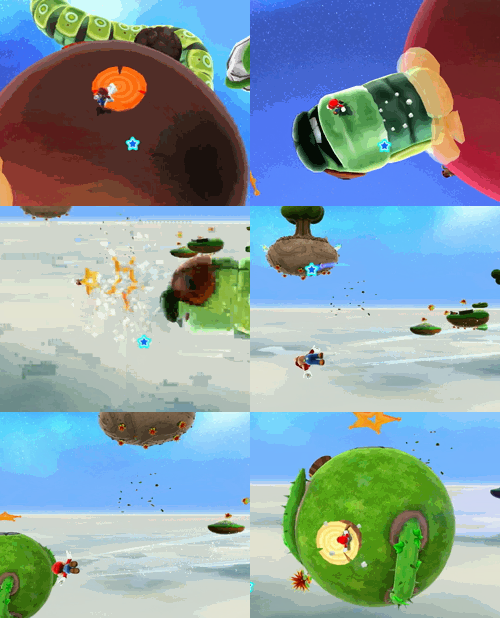
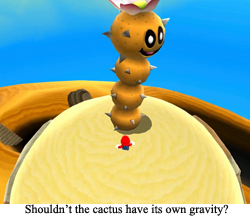
 What is new about Super Mario Galaxy? Well, it’s amazing. Mario’s moveset is back to Super Mario 64 levels, though with the addition of a spin attack instead of a punch. That makes sense! Mario was never much of a punching guy, and the spin is simultaneously a callback to his Super Mario World A-Jump, and an extra opportunity for recovery when Jump Man is doing his thing. Additionally, we have a few Wii baubles, like pointing and “grabbing” stars, or shooting star bits at opponents/hungry lil’ guys. But most importantly, the real new feature of Super Mario Galaxy is gravity. Mario is running over planets and satellites, and many of these planetoids are explorable from a completely 360° perspective. The universe is a series of titanic tennis balls! And since Mario used to fall off anything at the nearest right angle, it is a wholly new experience to be able to run ‘round these round constructs. And jumping between planets? You take it for granted about ten minutes after starting the game, but the weight of the physics happening in Super Mario Galaxy is something that had never been seen before. Eat a bag of shards, Sonic Adventure 2, this is how you put Chao in space.
But the general goals of Super Mario Galaxy appear to be the same old thing. For eleven years of 3-D Mario titles, you had the same basic task: collect enough stars/shines to unlock the next area, and then you can make a pass at collecting all 120 shinies to prove you are a super player. Sometimes these objectives are hidden in secret slides, or perhaps tied to an endless array of blue coins, but the end result is the same: there are 120 challenges, big and small, all across this world. Complete ‘em, and you have officially beat the game.
However, the devil is in the details. Yes, there are 120 stars to find, but the individual “value” of the stars varies wildly. This, too, could be nothing new: Mario 64 had its great big painting worlds, but also small “challenge” areas like the Bowser checkpoints or the secret areas. Similarly, Super Mario Sunshine had wide open spaces at its vacation locales, but also those deliberately constrained, FLUDD-less a cappella stages. Super Mario Galaxy initially appears to do the same: there are “big, explorable” galaxies like Honeyhive Galaxy or Beach Bowl Galaxy, but there are also short, punchy stages like Flipswitch Galaxy or Sweet Sweet Galaxy. Same as it has always been, and maybe you can preemptively sus out the nature of the challenge from the number of obtainable stars. You know you are not going to spend all week in that one galaxy that is just riding a manta ray…
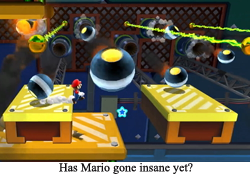 But you want a preview of the Mario to come? Let’s take a closer look at Battlerock Galaxy.
Initially, Battlerock Galaxy is presented as one of those large, explore ‘em up stages. There are seven total stars available, and multiple goals all across the worlds involved. But when you break ‘em down…
- Battlerock Barrage – Goal: Get through about ½ of the level
- Breaking into the Battlerock – Goal: Get through about 90% of the level
- Topmaniac and the Topman Tribe – Goal: Get through 100% of the level, including a boss
- Topmaniac’s Daredevil Run – Beat that boss without taking a hit
- Purple Coins on the Battlerock – Battlerock Barrage again, but with more doodads
- Luigi Under the Saucer – Battlerock Barrage again, but with a slightly different final goal
- Battlerock’s Garbage Dump – Play a (the worst) minigame in a hidden area
So when you really get down to it, the main stars are just one level broken up into three chunks, one hidden goal, and three “challenges” that may as well reward you with a 1-up. Yes, putting on the veneer of “you saved Luigi” is always appreciated, but it is still just slapping a series of “stage goals” on something that should be one, straightforward level. This Galaxy could have been an email.
And then, a few hours later, you get the Drednought Galaxy, which is the exact same setup with the exact same boss and the exact same garbage dump minigame! You already stretched one galaxy to the breaking point! You didn’t need to do it again!
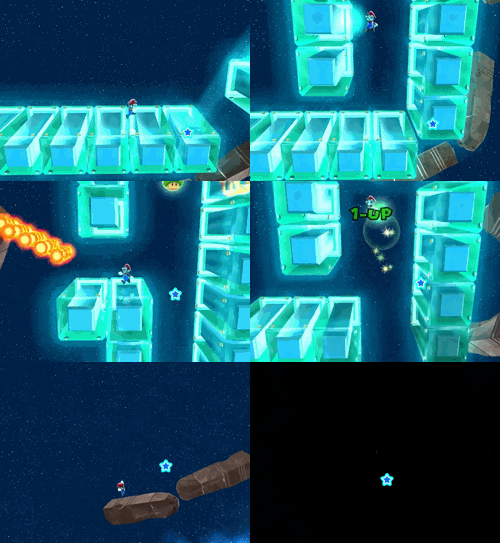 To be perfectly clear, Battlerock Galaxy and Drednought Galaxy are not in any quantifiably way “bad”. They’re all good levels, Brent. But sometimes there is a straightforward difference between the more “explorable” places like Ghostly Galaxy or Gold Leaf Galaxy, and the stages that are ostensibly presented as “explorable”, but are just challenge stages of a different flavor. Could the designers of Super Mario Galaxy get their stars together and separate the two in more obvious ways? I, a reasonable and mature Mario player, would like to know if Melty Molten Galaxy is going to take all afternoon, or be over in a flash like Matter Splatter Galaxy. I have places to be, Mario! You’re a plumber! You know about billing by the hour!
If you look at the Mario franchise after Super Mario Galaxy, you can see where the seams separated, and our favorite plumber did not have this problem again. Everything from this point on was one kind of Mario or the other.
A list of Mario titles released after Super Mario Galaxy.
- New Super Mario Bros. Wii – A direct sequel to New Super Mario Bros, meant to capitalize on the Wii’s multiplayer popularity. A 2-D Mario adventure consisting of mainly challenge stages with a deemphasis on exploration.
- Super Mario 3D Land – A new 3-D Mario adventure consisting of mainly challenge stages with a deemphasis on exploration.
- New Super Mario Bros. 2 – A new 2-D Mario adventure consisting of mainly challenge stages with a deemphasis on exploration.
- Super Mario Bros. U – A new 2-D Mario adventure consisting of mainly challenge stages with a deemphasis on exploration.
- Super Mario 3D World – A new 3-D Mario adventure consisting of mainly challenge stages with a deemphasis on exploration.
- Super Mario Maker – A whole new experience where you can play and build challenge stages.
- Super Mario Odyssey – A new 3-D Mario adventure consisting of mainly exploration stages where you are continually rewarded for exploring the world.
- Super Mario Maker 2 – The sequel to Super Mario Maker where you can play and build challenge stages.
- Super Mario Bros. Wonder – A new 2-D Mario adventure consisting of mainly challenge stages with a deemphasis on exploration.
 And that’s how the Yoshi’s Cookie crumbles. From the moment Super Mario Galaxy was released, Mario gave up on the kind of experimentation that defined his first two decades, and primarily focused on just taking the established Mario formula into a series of bite-sized challenges. Sure, you might get a Yoshi bubble blaster or golden shell along the way, but it is all still run, jump, and bop your way to goalposts. Anything that is “experimental” Mario gets shuttled off to its own little franchise (go have your own story, Yoshi!), and we are granted “a big adventure” every other console or so. No more games where there are deviations from the norm to be found.
Oh, wait… Did I leave a game off of that list? Ah, yes. There was Super Mario Galaxy 2.
Super Mario Galaxy 2 could not make its intent more obvious. Gone is Rosalina’s observatory at the middle of multiple galaxies, and now we have a Mario-shaped spaceship that proceeds forward through six (or seven) worlds, each containing seven individual galaxies. There are comets and challenges in each galaxy again, but they are much more “get to the end of the level”-based than even the smallest galaxies of the prequel. The showcased retro stage, Throwback Galaxy, simulates not Bob-Omb Battlefield of Mario 64 (its clear Level 1-1), but Whomp’s Fortress, the first and most climb-the-tower-beat-the-boss stage of that game. There will be no Koopa the Quick in Super Mario Galaxy 2, just basic excuses to run, jump, and bop your way to goalposts.
The message could not be more clear: Mario tried that whole other thing in Super Mario Galaxy, and we won’t be doing that again for ten years.
So please enjoy Super Mario Galaxy, the last and greatest Mario game that tried to do everything all at once. Mario’s galaxy got much more rigid after 2007, but we will always be able to play the one game where an entire omniverse seemed possible. Now we can look back at some of these levels not just as playgrounds for Mario, but the last gasp of a time when “a level” could mean anything. The last time the Mario franchise was a playground.
Super Mario Galaxy is the epitaph for Mario experimentation. Now we are forced to settle for games that are only amazing and fun.
SBC #50 Rosalina & Luma & Super Mario Galaxy
Rosalina & Luma in Super Smash Bros Ultimate
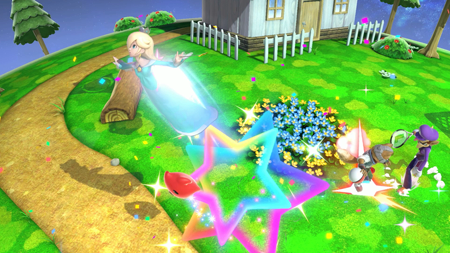
- She any Good? Back in the Smash 4 days, there was the recurring statement that Rosalina & Luma were meant to replace the gimmick of the absent Ice Climbers. I still don’t see it. Luma has some fun ranging properties, but this is nothing like Nana bouncing all over the place while Popo tries to blow some ice. Anywho, the Rosalina we got is appropriately low-gravity and has some surprisingly fun normal attacks (check out her meteor kick). And she is yet another character that proves items-being-on is an integral part of Smash Bros. The truth hurts, Final Destination.
- That final smash work? Rosalina summons a Grand Star over her head, and it has general black hole properties. I would normally call this boring, but what else is Rosalina going to do for a final smash? Summon Lubba?
- The background work? Mario Galaxy: The Stage is a cool looking reimagining of the iconic Gateway Galaxy. It also has unique gravity properties, which is very evocative of its parent game. But once you get past that? It’s boring. Could you maybe have some meteors hit the planet? Captain Toad attack? Something?
- Classic Mode: One Star After Another sees Rosalina defeat a series of space-based opponents. Ridley gets the Brinstar Depths instead of his usual Norfair, thus satisfying the condition of getting a weird little planet in there. Rosalina teams up with Mario to take down Bowser, and then Giga Bowser is forsaken for Marx in his starf$&*er form. Protect our galaxy from evil clowns, Mario & Rosalina!
- Smash Trivia: Since Rosalina has that hair tuft over her right eye, she is the only playable Mario character in Smash Bros. that does not perfectly mirror down the center. Given she also premiered on later hardware, this makes her the Gil of the Mario Universe.
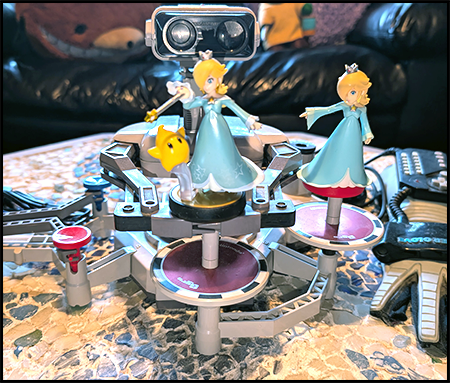
- Amiibo Corner: Our Smash amiibo has a little bouncy Luma, and a surprisingly detailed star wand. And she has stars on her dress! That’s cool detailing! The Mario Party Version looks like the budget value copy of Rosalina, but still has starry details like painted fingernails. Also, she appears to be bigger and blonder. Is this because she is a heavyweight in Mario Kart?
- Does Smash Bros Remember Today’s Game? A lot of people discount how Rosalina was a featured player in Super Mario Galaxy… and has mostly only cameoed or appeared in sports games since. She is barely part of Mario canon! So it is worth noting that Super Smash Bros Ultimate features Super Mario Galaxy in multiple ways, but, more importantly, does more to establish Rosalina as “important” than her parent franchise. Hopefully Super Mario Galaxy: The Movie will help out in that department, too. She can be Peach’s sister or whatever.
Rosalina & Luma in Super Mario Galaxy
 System: Nintendo Wii is where Rosalina got her start, but there were ports over to Nintendo Switch and Nintendo Switch 2 as anniversaries allowed. You can technically play it on the WiiU, too.
- Number of players: Get your little brother to control
Tailsstar bit shooting. Fun for the whole family! - Port-O-Call: For this article, I played through the entirety of the Nintendo Switch 2 port of Super Mario Galaxy. I genuinely do not know if this version/system has better motion controls, general gameplay has been recalibrated, or I have just gotten better at games in the meanwhile, but I did have an easier time with motion control-based manta ray and balancing ball bits. I mean, I still died a hundred times, but when I got those stars on the Wii, I died a thousand times.
- Back and Better than Ever: After his premiere in Super Mario Sunshine, Bowser Jr. is back as a secondary antagonist. Now that he doesn’t have anything to say beyond “ha ha ha” and “I’ll get you,” he is a much more tolerable presence. I do not want my baby godzillas to have mommy issues, I want them to stomp around and control giant robots. I am a simple man.
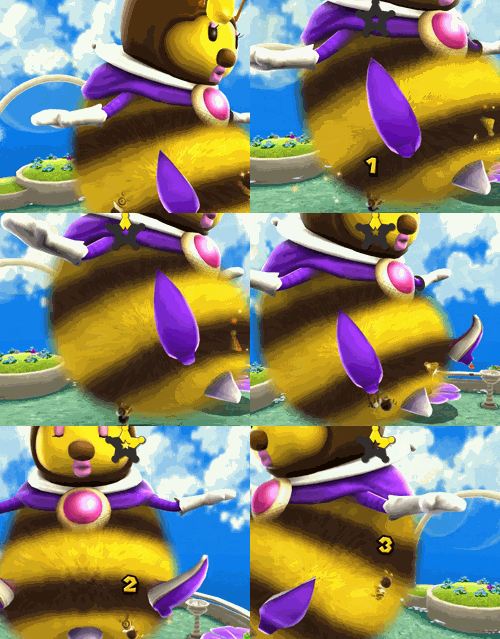
- Favorite Power-Up: Mario was always meant to wear a bee costume and buzz around. My personal conspiracy theory is that Nemo got there first, and then Nintendo had to hold off on Bee Mario for a decade or so. But now Bee Mario is here, and he can crawl around a giant, fuzzy queen all he wants.
- Favorite Galaxy: It seems to be a recurring theme in Mario games (and pretty much any platformer) now, but the Freezeflame Galaxy and its switch between fire and ice was pretty damn novel back in its day. Lava and ice flows smooshing into each other will always be fun! Also: Mario gets to ice skate, and he is surprisingly graceful.
- Say something mean: A lot of people complain about Spring Mario, but the source of my anxiety is any “collect 100 purple coins” level that includes instant death traps. In all of history, there is nothing worse than scoring 92/100 purple coins, missing a jump, and then losing all of your progress to quicksand or a black hole. Back to square one of meticulously grabbing every last shiny…
 Did you know? This game was officially ported to Nvidia’s Shield TV in China in 2018 thanks to a partnership with iQiyi. That was a gaming system that did not have Wii’s motion control capabilities at all, so a lot of the luma duties were transferred to a second analogue stick. So, ya know, the whole “this game needs a wiimote” excuse for ports did not even last a year…
- Would I play again: Release this on the Nintendo Switch 72, and I’ll still give it another go. Super Mario Galaxy may be a game confused about what it wants, but how it plays is glorious.
What’s next? Random ROB has chosen… Scott Pilgrim EX! Let’s go fight the world all over again! Please look forward to it!