

Carpathian Night Starring Bela Lugosi draws on significant lore from throughout human history. But how wide is that breadth of its mythology? Well, it all starts a few millennia back with…
Hell (650 BC)
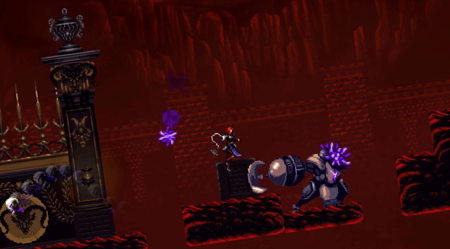
You fight a lot of demons in Carpathian Night Starring Bela Lugosi, and one could argue that the mythology of “demons” has been around since the first caveman got spooked by a shadow (it was just a sabretooth tiger. Nothing to worry about). So analyzing the exact origins of those myths would take all day. However! You do visit the demon’s realm in CNSBL, and it is the modern depiction of hell (albeit with more gravity platforming tricks). And where did we get Hell as we know it? You might think it came from Christianity, but hellfire predates Jesus by a few centuries. There is significant evidence that the Book of Joshua of the Hebrew Scripture/Old Testament significantly impacted our interpretations of The Bad Place.
Basically, there is Gehenna, which was a borderland mentioned in Joshua 15:8, where there may have been a bit of fiery child sacrifice. Never a good thing! Given nobody wants to deal with becoming extra crispy to appease God, the idea of Gehenna being associated with a fiery death persisted for centuries. It also didn’t help that Gehenna (or the Valley of Hinnom) was, as a borderland, kind of a literal flaming trash heap. Gotta torch your trash somewhere. And you know where nobody wants to hang out? A burning pile of garbage. In time, tales of this location comingled with the Greek/Roman Hades afterlife, and the depictions of Hell as we know it became a fiery place for the damned.
And now you can visit it in multiple videogames! Let’s all go to Hell!
Bible (325 AD)
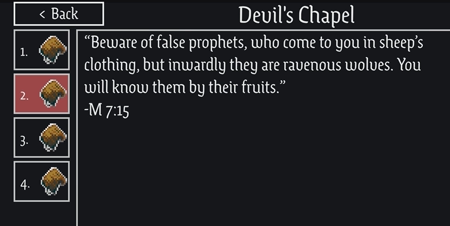
You can find four lore entries per level in Carpathian Night Starring Bela Lugosi. Each entry is about a paragraph in length, and they cover topics that are gameplay related (look for blue flames to find secrets!) or general story shading. Sometimes you discover the origin of the boss of a level, and sometimes you get details on that Dracula guy. Oh, and while there is a general undercurrent of “Christianity” throughout this whole adventure, some of the lore dumps are just straight up Bible verses.
People have a tendency to call the Bible 2,025 years old, but think about it for a second: if they were writing about the death of Jesus, then that thing could not be any younger than 1,993 years old, ya doofus! And there was a lot of stuff that happened after That Guy kicked off the mortal coil, too! Point being, there is not evidence of a complete Bible until around the 300’s, and that is only because we dug up the Codex Sinaiticus in 1884. Give or take an Epistle of Barnabas, this is basically the Bible we have today, so any and all quotes are a meager 1,700 years old. Direct Bible quotes are younger than the concept of demons or a fiery afterlife. Still older than Shakespeare quotes, though. Take that, you spoony bard.
Witch Trials (1400 AD)
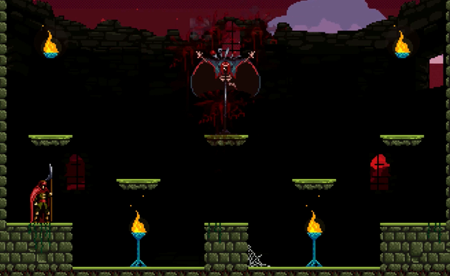
Shortly before reaching Dracula’s castle, Carpathian Night Starring Bela Lugosi takes our heroes through the grounds of a witch trial. The final boss of this level is identified as the undead manifestation of the only real witch that was ever burned at the stake, and every other woman killed in the name of witch hunting is acknowledged as having been innocent. Appropriate that a game where you are cutting down zombie hordes features a depressing amount of death for no reason.
And, honestly, that’s about how the actual witch trials went. Fun fact: it is 2025, and we still have yet to verify the existence of magic. Thus, proving someone is a witch is utterly impossible. However, witch trials as they are commonly remembered (see Monty Python and the Holy Grail for a historical depiction) occurred from about 1400 nearly 1800. That is four hundred years of witch trials, with roughly 40,000 to 60,000 women executed over those centuries. Nowadays, we can identify that most of these “witch hunts” were started over selfish reasons like church overreach (the local priest wants that property, and it would be easier if that widow was dead) or local disputes (that neighbor wants a bigger yard, and it would be easier if that widow was dead), but the concept of “witches” as malevolent women casting all sorts of wacky spells is still persistent imagery. And a witch that was burned at the stake? Appropriate for both Europe (which contained a lot of witch trialing) and America (where Salem gets all the credit). This is just the latest example in six centuries of asking which witch is which.
Bram Stoker & Dracula (late 1800’s)
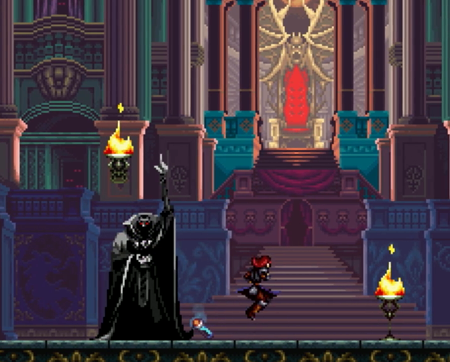
Yes, the ultimate opponent in Carpathian Night Starring Bela Lugosi is Dracula. But it is not Vlad the Impaler! Many myths about Dracula are based on Vlad III (aka Dracula, son of Vlad II Dracul), but the lore of CNSBL distinctly notes that Vlad the Impaler was some other guy from two towns over! Do not confuse our scholomancer with that dork!
So everybody knows of Dracula, but maybe go ahead and read a century-old book sometime to learn the true origins of our favorite vampire. And then study Bram Stoker extensively to find that he pulled together all sorts of myths to produce Dracula… but may have gotten a few things wrong. Like the whole Dracula name? Probably just Bram misunderstanding and believing “Dracula” to be Romanian for “devil”. Similarly, the whole “vampire blood” thing is likely based on stories of Elizabeth Báthory, whom many believed was the exact kind of noblewoman to bathe in the fluids of murdered peasants (the kind of practice that is only seen nowadays on Twitter). And speaking of the nobles, when you get right down to it, the big myths of Dracula and associated vampires mostly just originate in rumors and misunderstandings of the upper classes. Dracula is a master of scholomance, which is supposedly a kind of black/”devil” magic. But in the general context of Bram Stoker’s Dracula, it is just another way of saying the dude could afford an education and an attendant pile of books (and maybe an excuse for why he can turn into a wolf). Point being is that so much of the origin of fictional Dracula is based on a general fear of foreign nobles rolling into town and seducing all of our local ladies before a Hellsing shows up. In another story, this supernatural creature would just be some random Italian dude (this is not racism: look up The Italian). But Dracula was at least a little magic in Bram Stoker’s novel, so things got exaggerated just in time for…
Bela Lugosi & Dracula (1931)
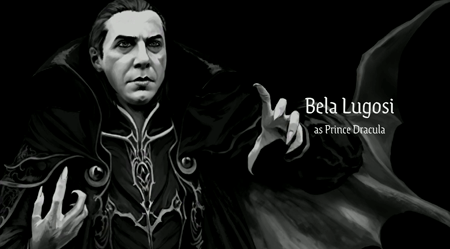
Never underestimate the appeal of a good copyright claim! Or a bad one! Nosferatu was released in 1922. It was a hit! It was also (eventually proven to be) extremely illegal, as great swaths of the story heisted bits from Bram Stoker’s Dracula. But, legal or not, Count Orlok established the vampire mythos for a much wider audience than ol’ Bram, and, complete with introducing new concepts like sunlight being wholly fatal, this was what people of the 20’s imagined when they thought of nefarious counts. Realizing there was gold in them thar Transylvania hills, Universal Pictures secured the legal rights to Bram Stoker’s Dracula. Basing a movie on the stage play from 1924, Universal released Dracula in 1931. Sure, Nosferatu beat them to the punch by nine years, but the irresistible charm of Bela Lugosi catapulted the count into the national consciousness.
And then Bela Lugosi appeared in Mark of the Vampire, The Return of the Vampire, and Vampire over London. He also distinctly portrayed Dracula on The Paul Winchell Show, Abott and Costello Meet Frankenstein, and Hollywood on Parade. Basically, if you missed Bela in Dracula for some odd reason, he would likely showcase his aversion to garlic somewhere in your media. He was the Taylor Swift of people that eat people! As such a cultural touchstone (and because Universal could not copyright “the concept of a vampire” separate from Dracula), the evolution of Bram Stoker’s Dracula as Bela Lugosi’s Dracula became the standard for undead aristocrats. By thirty years later, there were more Dracula-themed pornos than Bram ever could have imagined nearly a century earlier.
And, yes, Carpathian Night Starring Bela Lugosi draws heavily from Bela Lugosi’s Dracula. There is a Dracula, and he is played by Bela Lugosi. Do… uh… Do I need to explain that further? Maybe I can actually get around to talking about the gameplay now…
Castlevania Franchise (1986)
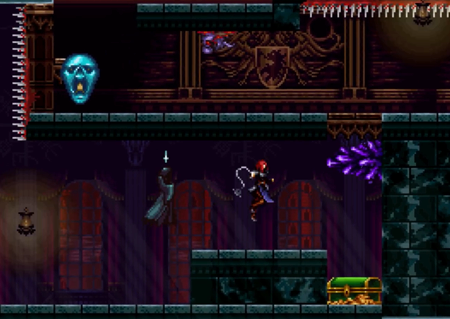
Tell me if you have heard this one before: You are hunting Dracula. You have a choice between two characters, and you must venture through multiple successive stages to eventually tromp through a haunted castle. Your main weapon has reasonable reach, but you have a number of sub-weapons that can be used to attack from different angles. In order to use your sub weapons, you must destroy candles and other light sources to obtain powerups. Bottomless pits are everywhere, and your most likely cause of death is being knocked back by a random, floating monster. Dracula waits in his throne room, but don’t worry, there is a secret spot just before the encounter where you can fill up on hearts and magic power.
Granted, not everything about Carpathian Night Starring Bela Lugosi is Castlevania. For instance, when you find “hearts”, they do actually restore your health, and are separate from the items that power your sub weapons. Additionally, there is an emphasis on finding hidden items in every area, and that segues into a pseudo-leveling system where your “sub weapons” are unlocked gradually. And the monster designs are (thankfully) original enough to not be immediately identified as Rondo of Blood sprites. But if you close your eyes and feel the vibes (and then immediately stumble into a chasm), this is a classic Castlevania game in everything but name. And if you really want a name…
Castlevania II: Simon’s Quest (1988)
The fourth stage involves venturing through a “guest house” outside Dracula’s castle. The lore entries tell the tale of a cursed man who ventured through various mansions burning Dracula’s heirlooms. In the end, he was successful, but the immortal Dracula revived the warrior years after his death. Now, an undead revenant of the man stalks the mansion.
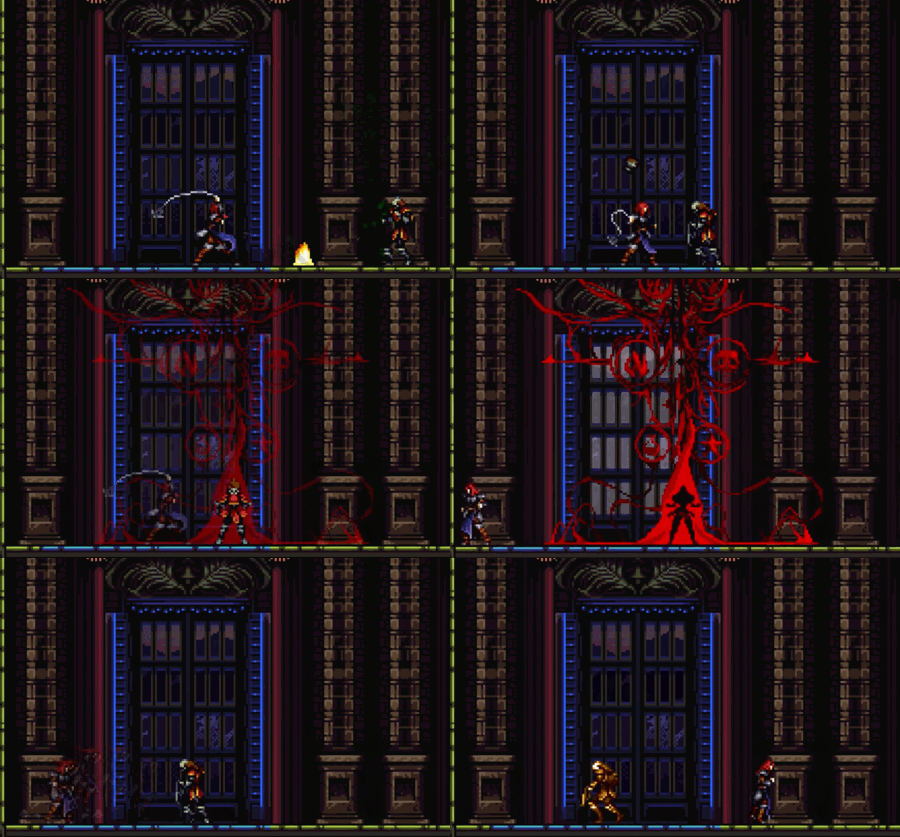
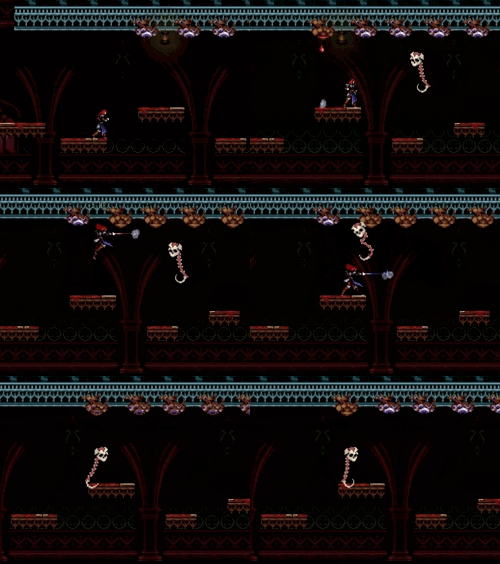
And his attacks are very familiar.
So, in summary, Carpathian Night Starring Bela Lugosi draws on myths that haunted our earliest ancestors just the same as 80’s kids that were forced to huddle behind Nintendo Power for safety. Quite the spread of human history for one 21st Century videogame.
FGC #716 Carpathian Night Starring Bela Lugosi
- System: Looks like we have Steam and Nintendo Switch for this one.
- Number of players: You have a choice between a spear-wielding 42-year-old, or an immortal Dracul mama. Unfortunately, you can only play as one of these luminaries at a time.
- Blood Descendant: Despite the fact that one of your playable characters is wielding a spear, the poor guy cannot high jump like Eric Lecarde of Castlevania: Bloodlines. This is a tragedy.
- What’s in a name: I traditionally enjoy the moniker “Metroidvania”, but it does mean we have to invent the term “Classicvania” to describe this vanialike that is more based on the Belmont adventures from before Alucard took a starring role.
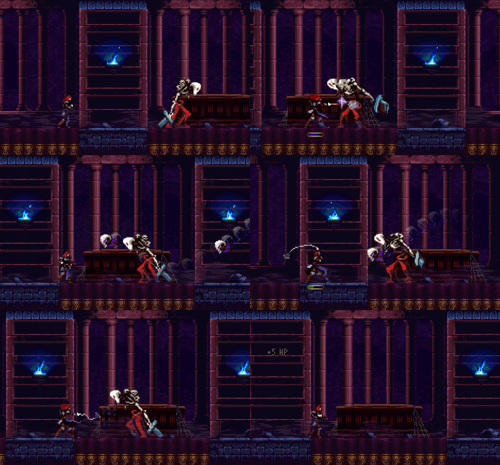 Innovations: Luckily, the “classic” nature here is not an excuse to limit your options. You can whip/stab in 8 directions! You have a slide! You can crouch-walk! And some of the spells have weird additional purposes like bouncing around fire bombs like basketballs. 90% of this game feels like it could be from the 80’s, but that other 10% knows how to make the genre sing for modern audiences.
- Willie Don’t Care: There is not a life count, and you are rewarded for finishing any stage without dying. This is great! Though the downside is that once you die once, there is literally no reason to care about dying another 99 times. Oh well, at least it means moving platform sections are technically less stressful.
- Favorite Boss: The Vampire Sisters are a trio that is the combined boss of The Crypt. Unlike a lot of the big guys, the fight is primarily about managing the threesome and keeping the whole gang on one side of you so as to avoid some literal backstabbing. It is an excellent change of pace from the other bosses that are predominantly based on projectile dodging.
- Say something mean: With eight buried collectibles in each stage, a maiden voyage through any given area means pressing up against every flat surface in a desperate attempt to find hidden passages. It is not an issue on return visits, but early trips feel too much like Dragon Quest “click on every barrel you have ever seen for mini medals” nonsense.
- Goggle Bob Fact: This is my favorite cat featured in the credits.
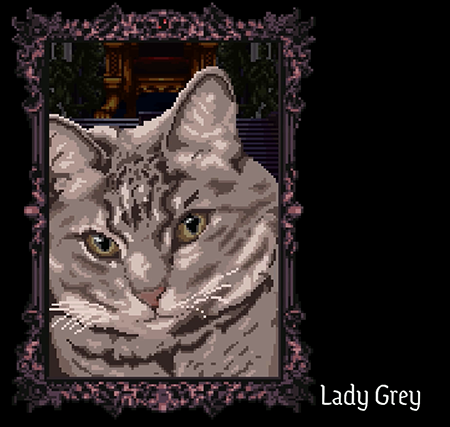
Now you know. - Did you know? In the credits of the original Castlevania, Bela Lugosi is credited as having played Death, Drac’s right hand man. The starring role goes to Christopher Lee. Philistines.
- Would I play again: Probably yes! This is a very enjoyable Classicvania, and the levels are easily digestible in small bursts. I could see hitting some of the more complicated platforming sections again just to see if I still have the skills to survive. Not like I did the first time…
What’s next? Random ROB has chosen… Castlevania Legends! A for-real Castlevania! I’m sure we’re all going to enjoy it! Please look forward to it!
You get used to it